
Field Notes
Field Notes #15: What a Support Line Can Tell Us
A new database describes 25,419 Fireside peer-support interactions. It offers a view of help-seeking, not a league table of drug risk or proof that support works.

Field Notes — standalone mid-week pieces from The Alkaloid on specific stories worth understanding.
Field Notes
A new database describes 25,419 Fireside peer-support interactions. It offers a view of help-seeking, not a league table of drug risk or proof that support works.

Field Notes
Nine studies, 537 adults, and a very uncertain answer. A Cochrane review on cannabis for insomnia shows why feeling sleepy and treating insomnia need separate evidence.

Field Notes
Four former psychedelic-trial participants describe life after the final visit. Their accounts raise questions about aftercare, with company involvement disclosed.
Field Notes
A new US survey records health changes people attribute to five psychoactive drugs. Its small subgroups and different recall windows matter as much as the headlines.
Field Notes
Gabon wants a share of the ibogaine boom. New reporting exposes the distance between paying for bark and sharing the value created afterward.

Field Notes
Cannabis-friendly social spaces need more than a place to consume. St. Louis offers a look at the work of hosting.

Field Notes
THC drinks borrow the rituals of a night out. Familiar packaging does not make the intoxicant familiar.
Field Notes
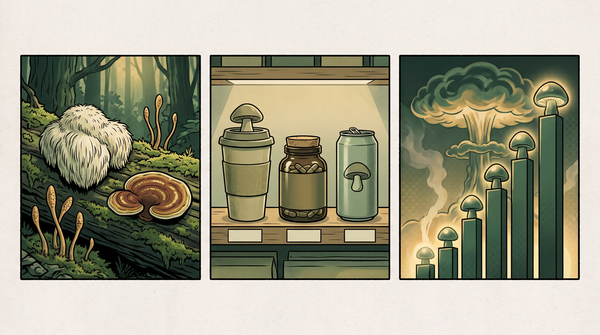
While psychedelic mushrooms fight for legal status, their boring cousins quietly became a near-$85 billion wellness industry. What the science on lion's mane and reishi actually shows — and where the marketing gets ahead of it.
Field Notes
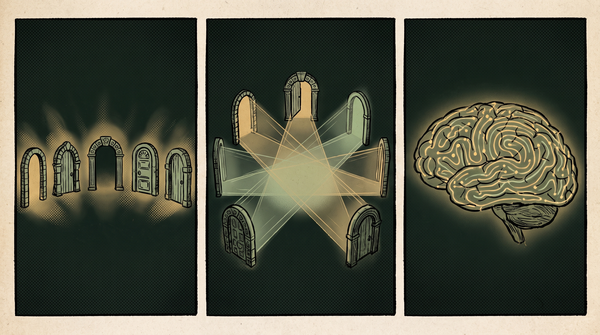
Psilocybin, LSD, DMT, mescaline, ayahuasca — five different molecules. A Nature Medicine mega-analysis of 267 people and 500+ brain scans found they all leave the same fingerprint: they don't quiet the brain, they connect it.
Field Notes
Psilocybin makes a magic mushroom magic. A new study shows two unrelated mushroom groups evolved it separately, by completely different chemical routes that meet only near the finish. Which raises the question decades of human fascination still can't answer: what is psilocybin actually for?
Field Notes
Jaguars roll in the ayahuasca vine. Reindeer hunt psychedelic mushrooms in the snow. Wallabies leave crop circles in Tasmania's poppy fields. The urge to get high isn't uniquely human — one researcher called it a fourth drive, as deep as hunger and thirst.
Field Notes
People are searching for "microdose therapy for chronic inflammation" and finding wellness sites that promise more than the science can back. Psychedelics show real anti-inflammatory promise in the lab. Whether a microdose delivers it in a human body is a different, much shakier question.