Field Notes #7: Five Doors, One Room
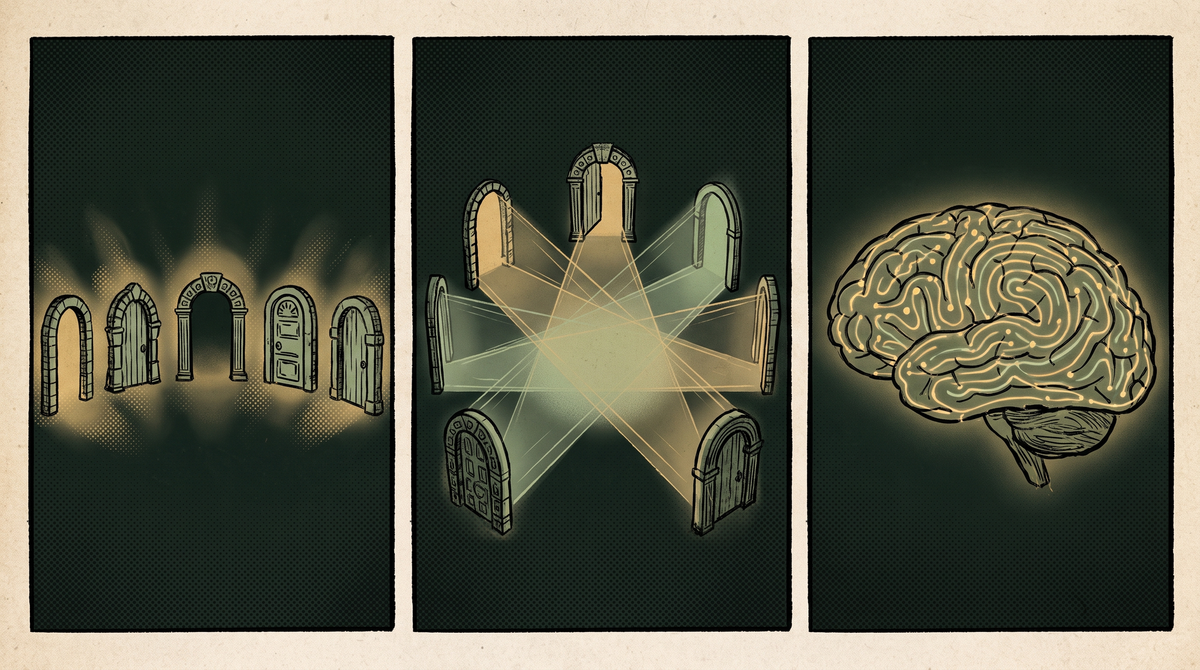
Psilocybin, LSD, DMT, mescaline, ayahuasca — five different molecules. A Nature Medicine mega-analysis of 267 people and 500+ brain scans found they all leave the same fingerprint: they don't quiet the brain, they connect it.
For sixty years, brain scans of psychedelics told a messy story. One study said the drugs quieted the brain. Another said they lit it up. A third pointed at the default mode network, a fourth at the thalamus, a fifth somewhere else entirely. Every lab seemed to find a slightly different animal, which is what happens when a dozen small studies use different drugs, different scanners, and different math.
A paper published this year in Nature Medicine did the unglamorous thing that finally cut through it. Instead of running one more small study, a team led by Danilo Bzdok at McGill, with collaborators including Manesh Girn and researchers at Washington University and Johns Hopkins, pooled eleven separate datasets — 267 people, more than 500 brain scans, gathered across five countries and three continents — and ran them all through the same pipeline. Same preprocessing, same model, one honest comparison.
They looked at five psychedelics: psilocybin, LSD, DMT, mescaline, and ayahuasca. Chemically these are not the same drug. They bind differently, last for wildly different lengths of time, and feel distinct to the people taking them. The expectation was that each would leave its own mark.
Instead they left the same one.
Underneath the chemistry sat a shared signature. Rather than shutting the brain down, the drugs connected it. The networks we lean on for high-order thinking — the default mode network, the limbic system — became far more coupled to each other than in a sober brain, and deep structures like the thalamus and basal ganglia started talking much more to the brain's sensory and motor circuits. The usual walls between "thinking" systems and "sensing" systems got thinner. Everything started listening to everything else.
The differences that remained were differences of degree, not kind. LSD and psilocybin produced nearly identical patterns. DMT looked like an amplified version of the same thing, the largest effect of the group, which fits its reputation as the most overwhelming of the classic psychedelics. Mescaline, the ancient one, belonged to the same family portrait.
What makes this matter is not any single detail but the fact of a common pathway at all. If five unrelated molecules push the brain toward one state, that state — not the receptor, not the plant — may be the thing worth studying. It gives drug developers a target to aim at and a way to ask whether a new compound is doing the real work or just approximating it. It also quietly explains why people describe such similar experiences after taking such different substances.
The caveats are the usual honest ones. Pooling other people's data inherits other people's choices. Correlation in a scanner is not the same as understanding a mind. And a shared brain signature does not tell you what any of it means to the person inside the scanner. But after six decades of contradictory snapshots, we finally have a group photo, and everyone in it is standing in roughly the same place.
— The Alkaloid
Field Notes is the mid-week dispatch from The Alkaloid. Forward this to someone who'd enjoy it. Subscribe at TheAlkaloid.com
Sources
- Girn M., Bzdok D. et al., "An international mega-analysis of psychedelic drug effects on brain circuit function," Nature Medicine (2026), DOI 10.1038/s41591-026-04287-9
- Technology Networks, "Psychedelics don't shut down the brain — they connect it" (2026)
- McGill University Newsroom, on the largest-ever psychedelics brain study (2026)