Field Notes #6: Two Roads to the Same Molecule
Psilocybin makes a magic mushroom magic. A new study shows two unrelated mushroom groups evolved it separately, by completely different chemical routes that meet only near the finish. Which raises the question decades of human fascination still can't answer: what is psilocybin actually for?
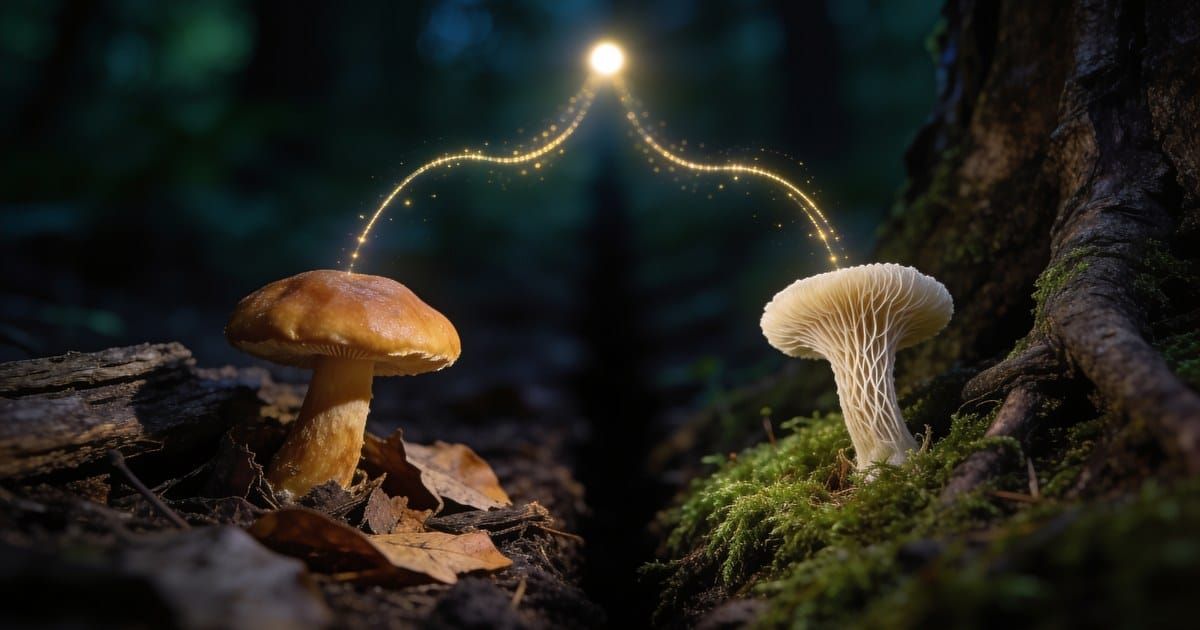
Psilocybin is the molecule that makes a magic mushroom magic. It is also, it turns out, a molecule that nature wrote twice.
A study published last fall in Angewandte Chemie laid out the surprise. A team led by Dirk Hoffmeister at Friedrich Schiller University in Jena compared how two unrelated groups of mushrooms, Psilocybe and Inocybe, actually build psilocybin inside their cells. Both start from the same raw material, the amino acid tryptophan. Both arrive at the same finished compound. In between they share almost nothing. Different enzymes, different steps, converging at a single shared intermediate before splitting off again.
“I never expected these two psilocybin pathways not to share any reaction,” Hoffmeister told Science. His own image for it is better than any I could write: it is like crossing Manhattan by two different routes and meeting, unplanned, in Central Park.
This is convergent evolution, the thing that happens when separate lineages stumble onto the same solution from different directions. Bats and birds both ended up with wings without sharing a winged ancestor. Eyes have evolved independently dozens of times over. The trick is common enough at the level of a trait. It is rarer and stranger at the level of a single, specific, fairly elaborate molecule.
Which leaves the question the study cannot answer. Why would two kinds of mushroom, living completely different lives, both invest in making the same psychedelic? Psilocybe species grow on decaying matter, on manure and wood mulch and the forest floor’s leftovers. Inocybe, the fiber caps, live in partnership with trees, threaded into their roots. They are not fighting over the same niche. They did not inherit the recipe from a shared ancestor. They each built it on their own, and each kept it.
“Nature does nothing without reason,” Hoffmeister said. “So there must be an advantage... we just don’t know what it is yet.” The leading guess is defense, that psilocybin scrambles the appetite or the nervous system of something that would otherwise eat the mushroom. A competing guess runs the other way, that the effect is the point, and that animals seek the mushrooms out and carry their spores in exchange for the experience. The honest answer is that after decades of human fascination with this molecule, we still cannot say what it is for.
There is something clarifying in that gap. We have spent a few years now talking about psilocybin almost entirely in human terms, as a treatment, a market, a schedule, a policy fight. The mushroom was making it long before any of that, for reasons that have nothing to do with us, and it apparently found the recipe worth discovering twice. Whatever psilocybin is for, it is not for us. We are just the latest species to take an interest.
The practical footnote is that two separate toolkits for making psilocybin are more useful than one. Each pathway comes with its own enzymes, so chemists who want to brew the compound cleanly now have a second catalog to work from. Yesterday’s news about engineered plants and fermentation tanks is downstream of exactly this kind of discovery, nature’s chemistry read closely and copied. Fungi, as Hoffmeister put it, are talented chemists. They have been running the experiment far longer than we have.
— The Alkaloid
Field Notes is the mid-week dispatch from The Alkaloid. Forward this to someone who’d enjoy it. Subscribe at TheAlkaloid.com
Sources
- “Magic Mushrooms Evolved Psilocybin Not Once, but Twice,” Smithsonian Magazine (Oct 28, 2025)
- “In a mind-bending twist, ‘magic’ mushrooms evolved twice independently,” Science (Oct 2025)
- Hoffmeister et al., Angewandte Chemie International Edition, DOI 10.1002/anie.202512017 (Sept 21, 2025)
- “Magic mushrooms invent active compound twice,” University of Jena statement (2025)
- “How Psychedelic Mushrooms Evolved Their Magic,” New York Times (Oct 18, 2025)