The Alkaloid #22: The Alarm That Didn't Ring
Past-month cannabis use among Minnesota teens fell from 13% to 5% across twelve years of steadily looser law, and the predicted spike never came. The decline also never reached Native, LGBTQ+ or low-income students, who were three times more likely to use in 2013 and still are today.
Science, culture and capital — one dose at a time
Issue #22 · August 4, 2026
THE DOSE
The Alarm That Didn't Ring
For as long as anyone has argued about legalizing cannabis, one prediction has done more work than all the others combined. Make it legal for adults and you will hand it to teenagers. It was the argument that moved parents, school boards and undecided legislators, and it was made in good faith by people who had watched tobacco and alcohol marketing find their way to children for a century.
Minnesota has now run the experiment for twelve years, and the Minnesota Student Survey has been counting the whole time.
Marla Eisenberg and colleagues at the University of Minnesota Medical School, the University of Connecticut and Hennepin Healthcare Research Institute published the results on July 23 in Social Science & Medicine. They pulled five waves of the survey, 2013 through 2025, with somewhere between 45,180 and 75,551 ninth and eleventh graders answering in each round. Past-30-day cannabis use went from 13 percent to 5 percent. The state's own health department puts past-year use at 14.9 percent in 2013 and 6.3 percent in 2025, and reports that 96 percent of students used nothing at all in the previous month.
Over those same twelve years Minnesota legalized medical cannabis in 2014, authorized hemp-derived THC products in 2022, and legalized adult recreational use in 2023. Every loosening was followed by more of the same decline.
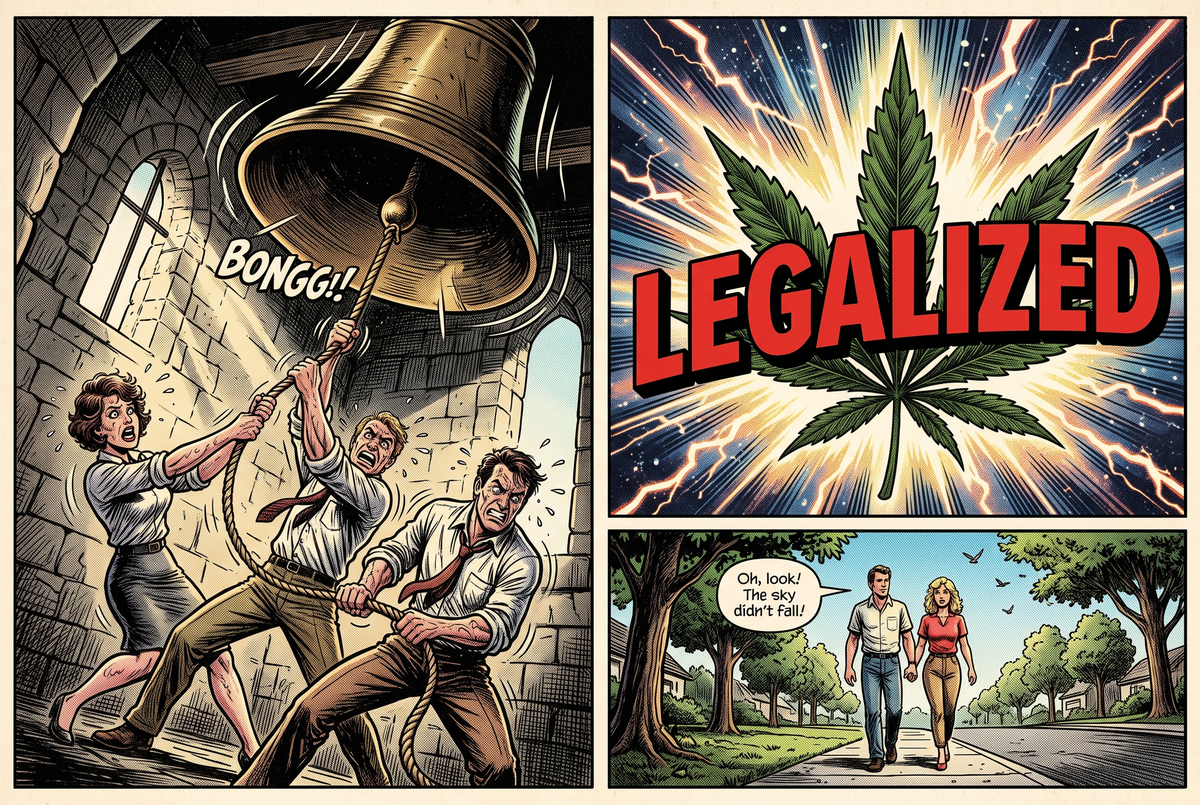
So the alarm didn't ring. That is worth stating plainly, because a lot of people spent a long time certain that it would.
It is also where most of the coverage stops, and where the study gets interesting.
The decline did not reach everyone. American Indian and Alaska Native students were three times more likely to use cannabis than white students in 2013. They still are. Students living in poverty were three times more likely then, and they still are. LGBTQ+ students were three times more likely, and Eisenberg's summary of that trend is the line worth keeping: the gap "got better for a while, but then got worse again."
One group moved. Black students were 51 percent more likely than white students to use cannabis in 2013. By 2025 they were 10 percent less likely. Nobody in the study claims to know why that gap closed while three others held perfectly still.
The authors are careful about what they are not saying. This is not evidence that legalization reduced teen use. They cannot identify the mechanism at all, and the candidates they float have nothing to do with drug law: closer parental monitoring, less unstructured time with other kids, a general shift in how this generation behaves. Teenagers are drinking less and smoking less too. Something larger is happening to adolescence, and cannabis is riding along with it.
Which means both of the obvious readings are wrong. The people who predicted a flood were wrong. The people about to argue that legalization protects children will be wrong in the same way, using the same missing counterfactual. Nobody knows what Minnesota's chart would look like under a different law, because there is only one Minnesota.
What we do know is that a very large number of kids stopped, and a specific set of kids did not.
QUICK HITS
- Germany got the same answer. The Federal Institute of Public Health pooled 12 representative surveys running from 2008 to 2025 and found no evidence of an immediate effect on youth cannabis use after the April 2024 legalization. The one increase, among young men, tracked a line that has been climbing since 2008. Published in the Journal of Health Monitoring.
- Manitoba checked the hospitals. Researchers at the University of Manitoba and the Manitoba Centre for Health Policy counted cannabis-related hospitalizations among everyone 18 and under from 2013 to 2023. Monthly average before legalization: 8.50. First phase after: 9.52. Second phase: 8.59. None of the differences reached significance. In the International Journal of Population Data Science.
- The national picture is flat and low. Monitoring the Future's 2025 round put past-year marijuana use at 8 percent of eighth graders, 16 percent of tenth and 26 percent of twelfth, unchanged from 2024 and still sitting at the lows established around 2021.
- Prenatal exposure. A study of more than 115,000 children found no increased risk of anxiety or depression associated with maternal cannabis use during pregnancy. Worth reading alongside, not instead of, the literature on birth weight and neurodevelopment.
- Nanoparticles and liver tumors. CBD packaged into engineered nanomicelles became 367 times more water-soluble, concentrated in tumors, and suppressed growth in mice at a level matching cyclophosphamide. Mouse work, published August 3 in the Journal of Drug Delivery Science and Technology.
That's the news. The analysis is below Science Desk, Market Watch, and a closing thought.
SCIENCE DESK
What a survey like this can and cannot tell you
The Minnesota Student Survey is a repeated cross-section, which is a specific and limited instrument. Every three years it asks a fresh set of students what they did last month. It never follows the same student twice.
That design is excellent for one job. If you want to know whether the population of Minnesota ninth graders is using less cannabis than the population of Minnesota ninth graders did in 2013, this will tell you, and with samples above 45,000 it will tell you with real precision.
It cannot tell you what happened to any individual. It cannot tell you whether the kids who would have started using instead started doing something else. And it cannot establish that any law caused anything, because there is no control group. The word doing the heaviest lifting in every headline about this study is "despite," as in use fell despite legalization. "Despite" quietly implies we know what would have happened otherwise. We do not.
There are confounds worth naming. The 2022 wave caught an adolescence reshaped by the pandemic, when unsupervised socializing collapsed and a lot of teenage behavior went with it. Self-report shifts as social norms shift, sometimes in the direction of admitting more and sometimes less. Survey participation itself changes over a decade.
The disparity finding deserves its own note, because relative and absolute risk pull apart here. A group being three times more likely to use when the overall rate is 13 percent, and three times more likely when the rate is 5 percent, describes very different numbers of actual teenagers. Far fewer American Indian and Alaska Native students are using cannabis today than in 2013. The gap in absolute terms narrowed simply because everything fell.
But the ratio held. Whatever pulled the general rate down by roughly 60 percent pulled these groups down by about the same proportion and no more. Nothing closed the distance. That is a different claim from "these kids got worse," and it is more useful, because it tells you the improvement was general rather than targeted. A broad tide moved everyone. No one built anything for the students who started furthest out.
MARKET WATCH
Florida's medical dispensaries posted a record July at $198.2 million, bringing the year to roughly $1.19 billion. Separately, a study this month estimated that recreational legalization raised agricultural employment by about 9 percent in states that adopted it.
Put that against the Minnesota chart and you get a fact the industry rarely says out loud and the industry's critics rarely notice. Legal cannabis markets are growing while adolescent use falls. Those two lines are supposed to move together in the standard story, where a growing legal market normalizes a product and recruits the next generation of consumers. In the United States over the past decade they have moved in opposite directions.
The commercial read is that this industry is growing on adults, mostly older ones, and that the demographic it was accused of chasing is the one segment steadily walking away. The regulatory read is that the packaging rules, age verification and advertising limits that operators complain about are the most plausible thing standing between those two lines. Neither read is proven. Both are more interesting than the argument everyone is still having.
THE LAST WORD
The people who warned that legal cannabis would end up in high schools were sincere, and they were working from a real history of exactly that happening with other products. They deserve a straight answer, and in Minnesota the straight answer is that it did not happen.
The finding that should travel further is the quieter one. Native students, LGBTQ+ students and students living in poverty were three times more likely to use cannabis in 2013, and after twelve years of falling numbers and changing laws they still are. Whatever reached everyone else never reached them. That is not a footnote to the good news. It is the part of the study with something left to do.
— The Alkaloid
SOURCES
- University of Minnesota — Less cannabis use among adolescents, but social disparities persist: https://twin-cities.umn.edu/news-events/less-cannabis-use-among-adolescents-social-disparities-persist
- The Marijuana Herald — Study Finds Teen Marijuana Use Fell More Than 60% From 2013 to 2025 Despite Legalization: https://themarijuanaherald.com/2026/07/study-finds-teen-marijuana-use-fell-more-than-60-from-2013-to-2025-despite-legalization/
- Minnesota Department of Health — Youth cannabis use continued to decline in 2025: https://www.health.state.mn.us/news/pressrel/2026/cannabis042026.html
- The Marijuana Herald — Study Finds No Immediate Increase in Youth Marijuana Use Following Germany's Partial Legalization: https://themarijuanaherald.com/2026/07/study-finds-no-immediate-increase-in-youth-marijuana-use-following-germanys-partial-legalization/
- The Marijuana Herald — Marijuana Legalization Did Not Increase Youth Hospitalizations in Manitoba: https://themarijuanaherald.com/2026/08/marijuana-legalization-did-not-increase-youth-hospitalizations-in-manitoba-study-finds-2/
- Partnership to End Addiction — Monitoring the Future survey: Teen substance use remains low in 2025: https://drugfree.org/drug-and-alcohol-news/monitoring-the-future-survey-teen-substance-use-remains-low-in-2025/
- The Marijuana Herald — Daily Cannabis News Brief for 8/3/2026: https://themarijuanaherald.com/2026/08/daily-cannabis-news-brief-for-8-3-2026/
- The Marijuana Herald — CBD Nanoparticles Suppressed Liver Tumor Growth in New Study: https://themarijuanaherald.com/2026/08/cbd-nanoparticles-suppressed-liver-tumor-growth-in-new-study/
- The Marijuana Herald — Study Finds Recreational Marijuana Legalization Increased Agricultural Employment by About 9%: https://themarijuanaherald.com/2026/07/study-finds-recreational-marijuana-legalization-increased-agricultural-employment-by-about-9/
The Alkaloid publishes every Tuesday. Forward this to someone who needs the dose. Subscribe for full access: TheAlkaloid.com