The Alkaloid #21: The Honest Third
Researchers pooled 28 studies covering 937 CBD products and found just 31.3 percent contained what the label claimed. Topicals came in at 13.8 percent. Plus undisclosed THC, synthetic cannabinoids, heavy metals, and why the number on the box can be wrong in four different ways.

Science, culture and capital — one dose at a time
Issue #21 · July 28, 2026
THE DOSE
The Honest Third
CBD won by being boring. It doesn't get you high, it doesn't require a dispensary, and it sits on the pharmacy shelf between the melatonin and the fish oil. That ordinariness is the whole product. People buy it because it feels like a supplement rather than a substance.
A review published this month in Phytochemistry Letters makes the ordinariness harder to trust. Researchers at the University of Malta pooled 28 analytical studies published between 2017 and 2025, covering 937 CBD products sold to consumers, and asked one plain question. Does the bottle contain what the label says?
For 294 of those 937 products, yes, within ten percent either way. That is 31.3 percent. Just under a third.
The failures are not evenly spread, and the pattern is the useful part. Oils and tinctures did best at 41.3 percent accurate. Edibles came in at 40.5. Vape products dropped to 24.3. Topicals finished last at 13.8 percent, which means roughly six of every seven CBD creams and balms tested did not contain what they claimed.
Then there is what turned up that was never on the label. The review found undisclosed THC, including one vape that measured around 45 percent. It found synthetic cannabinoids, the lab-made compounds behind the ugliest adverse-event reports in the entire cannabinoid space. It found heavy metals, specifically lead, mercury, arsenic and cadmium, alongside pesticides, phthalates and residual solvents, some of them above legal limits.
Gummies had a problem of their own. Products drawn from the same batch disagreed with each other, which the authors read as a mixing and manufacturing failure rather than a measurement one. If two gummies from a single jar don't match, no amount of testing at the end of the line rescues the person eating them.
The authors' summary is unusually flat for a journal. "Mislabeling, cannabinoid adulteration and chemical contamination remain widespread." Not isolated incidents. Not meaningfully improving across eight years of data.
The person this hurts is not the thrill-seeker. It is the retiree who bought a legal product from a legal store, read the label, took the dose printed on the box, and had no way of knowing whether she got fifteen milligrams, forty, or a synthetic cannabinoid that was never supposed to be in the building. She did everything right.
QUICK HITS
- Five years of back pain data. A retrospective analysis in Biomedicines tracked 241 treatment-refractory chronic low back pain patients on inhaled medical cannabis. Pain relief held across the full five years, and opioid use fell from every patient at baseline to 4.6 percent.
- Restless legs. A THC-CBD combination reduced symptom severity in a small trial published in the Journal of Neurology, with about two-thirds of participants still on treatment a year later.
- Refractory epilepsy. In a Brazilian cohort, 70.3 percent of patients with drug-resistant epilepsy saw seizures drop by at least half on cannabis-based products.
- Sunscreen, sort of. CBD and CBG reduced oxidative stress and inflammatory signaling in skin cells exposed to UVA light. Cell culture only, so nobody should be swapping their SPF for a balm yet.
- The mushroom nobody writes about. RAND's nationally representative survey put Amanita muscaria use at 3.5 million American adults in 2025, ahead of both ketamine and LSD. It is legal, unregulated, chemically unrelated to psilocybin, and almost entirely absent from the psychedelic press.
That's the news. The analysis is below — Science Desk, Market Watch, and a closing thought.
SCIENCE DESK
Why a label lies
A wrong number on a CBD bottle can arrive by four very different routes, and the label gives you no way to tell them apart.
The first is formulation. CBD is extracted from plant material that varies by harvest, and turning that extract into a finished product means diluting it into oil, gelatin, or an emulsion. Every one of those steps introduces drift. A pharmaceutical would be corrected against a reference standard at each stage. Most CBD manufacturing has no such requirement.
The second is degradation. Cannabinoids break down with heat, light and time. A gummy that was accurate the week it was made can drift well outside ten percent by the time it reaches a shelf in a hot warehouse, and shelf-life testing is rare.
The third is homogeneity, and it is the one the Malta review makes vivid. Getting an active ingredient evenly distributed through a batch of chewy candy is a genuine engineering problem. When it isn't solved, the average across a batch can look fine while individual units are wildly off. That is what jar-to-jar and gummy-to-gummy variation is telling you.
The fourth is simply that someone lied, or bought from someone who did. A vape sold as CBD that measures 45 percent THC is not a mixing error.
This is also why the accuracy rate falls so sharply by product type. Topicals are thick emulsions, hard to mix evenly and hard to sample cleanly, which is a plausible reason they landed at 13.8 percent. Oils are a solution in a bottle, the easiest case, and they still only managed 41.3.
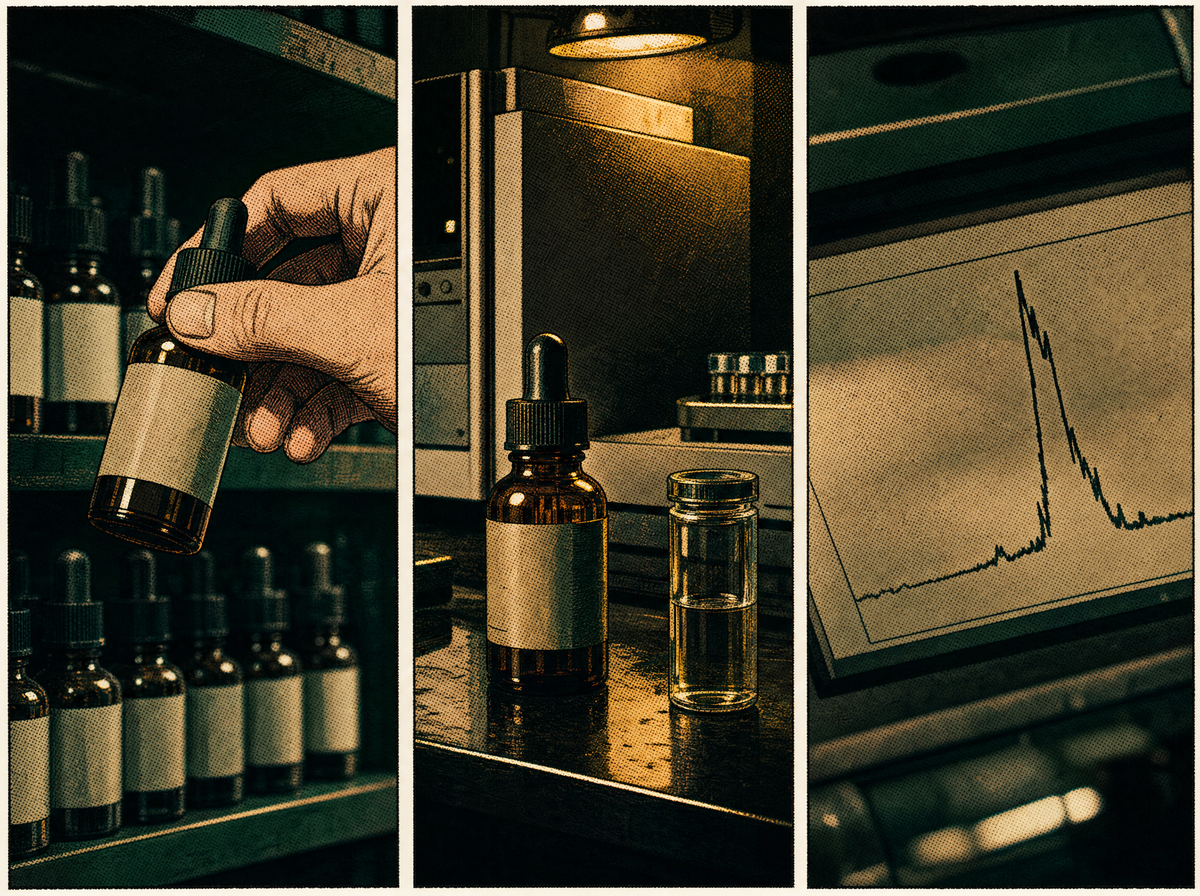
The practical defense is a certificate of analysis, and most people read them wrong. A COA is only worth something if it is batch-specific, with a lot number that matches the one printed on the product in your hand. A generic COA for the product line tells you nothing about your unit. It should come from an accredited third-party lab rather than the manufacturer, and it should cover more than potency. Potency alone will not catch lead, pesticides or residual solvents. If a brand won't show you a full-panel COA tied to your lot, that reluctance is the finding.
MARKET WATCH
Grand View Research put the global cannabidiol market at roughly $18.2 billion in 2025, with North America accounting for 66.5 percent of revenue and the United States taking 80.3 percent of that. The projection runs to $39.74 billion by 2033, a compound growth rate near 10 percent a year.
That growth rests almost entirely on a trust proposition. CBD is not sold on intoxication or on novelty. It is sold on the claim that a specific amount of a specific compound is in the package, which is exactly the claim the Malta review found holding up less than a third of the time.
The pressure is about to increase rather than ease. Hemp-derived THC beverages did $239 million in retail over the 52 weeks ending June 27, up 135 percent, according to NielsenIQ figures reported by Forbes, while beer, wine and spirits all declined. Buyers are migrating toward products where the dose is the entire point. A consumer who mis-doses a topical gets nothing. A consumer who mis-doses a 10-milligram beverage has a bad evening and a story to tell.
The counterintuitive read is that this review is good news for the serious operators. Full-panel, batch-matched COAs are expensive, and the companies already paying for them have been competing against rivals who don't. Independent evidence that most of the category is unreliable turns that spending into a moat.
THE LAST WORD
Nothing here says CBD is dangerous. It says the category got filed under wellness, and wellness is where we quietly agreed that precision doesn't matter much. Nobody would shrug at a 13.8 percent accuracy rate on ibuprofen.
The fix is unglamorous. Standardized potency methods, mandatory contaminant panels, batch-level certificates a customer can actually match to the thing in their hand. None of that requires taking a single product off a shelf, and all of it is the difference between a supplement and a medicine. Plant medicine keeps asking to be taken seriously. This is what taking it seriously costs.
— The Alkaloid
SOURCES
- NORML — Analysis: Many Hemp-Derived CBD Products Lack Accurate Labeling: https://norml.org/news/2026/07/09/analysis-many-hemp-derived-cbd-products-lack-accurate-labeling
- The Marijuana Herald — Review of Nearly 1,000 Products Finds Just 31% of CBD Products Accurately Labeled: https://themarijuanaherald.com/2026/07/review-of-nearly-1000-products-finds-just-31-of-cbd-products-accurately-labeled-with-contaminants-also-detected/
- Phytochemistry Letters — Label integrity of cannabidiol consumer products: a matrix-specific review of accuracy, contaminants, and regulatory gaps (2017–2025): https://www.sciencedirect.com/science/article/pii/S1874390026000947
- Biomedicines — Long-Term Inhaled Cannabis Therapy for Chronic Low Back Pain: A Five-Year Retrospective Analysis: https://www.mdpi.com/2227-9059/14/6/1255
- NORML — Inhaled Cannabis Provides Long-Term Relief From Low Back Pain: https://norml.org/news/2026/07/02/study-cannabis-inhalation-associated-with-long-term-pain-relief-opioid-sparing-effects-in-patients-with-treatment-resistant-lower-back-pain
- Journal of Neurology — Tetrahydrocannabinol/cannabidiol in the treatment of restless legs syndrome: https://link.springer.com/article/10.1007/s00415-026-13975-y
- The Marijuana Herald — Cannabis-Based Products Associated With Significant Seizure Reduction in Refractory Epilepsy Patients: https://themarijuanaherald.com/2026/07/cannabis-based-products-associated-with-significant-seizure-reduction-in-refractory-epilepsy-patients-study-finds/
- The Marijuana Herald — CBD and CBG May Help Protect Skin Cells From UVA-Related Damage: https://themarijuanaherald.com/2026/07/cannabis-compounds-cbd-and-cbg-may-help-protect-skin-cells-from-uva-related-damage-study-finds-2/
- RAND — Millions of U.S. Adults Microdosing Psychedelics: https://www.rand.org/news/press/2026/01/millions-of-us-adults-microdosing-psychedelics.html
- Grand View Research — Cannabidiol Market Size, Share & Trends Report: https://www.grandviewresearch.com/industry-analysis/cannabidiol-cbd-market
- Forbes — THC Drinks Face A Federal Deadline That Could Upend The Market: https://www.forbes.com/sites/noelburgess/2026/07/20/thc-drinks-federal-hemp-deadline-2026/
The Alkaloid publishes every Tuesday. Forward this to someone who needs the dose. Subscribe for full access: TheAlkaloid.com