Field Notes #11: Who Gets Paid for the Root?
Gabon wants a share of the ibogaine boom. New reporting exposes the distance between paying for bark and sharing the value created afterward.

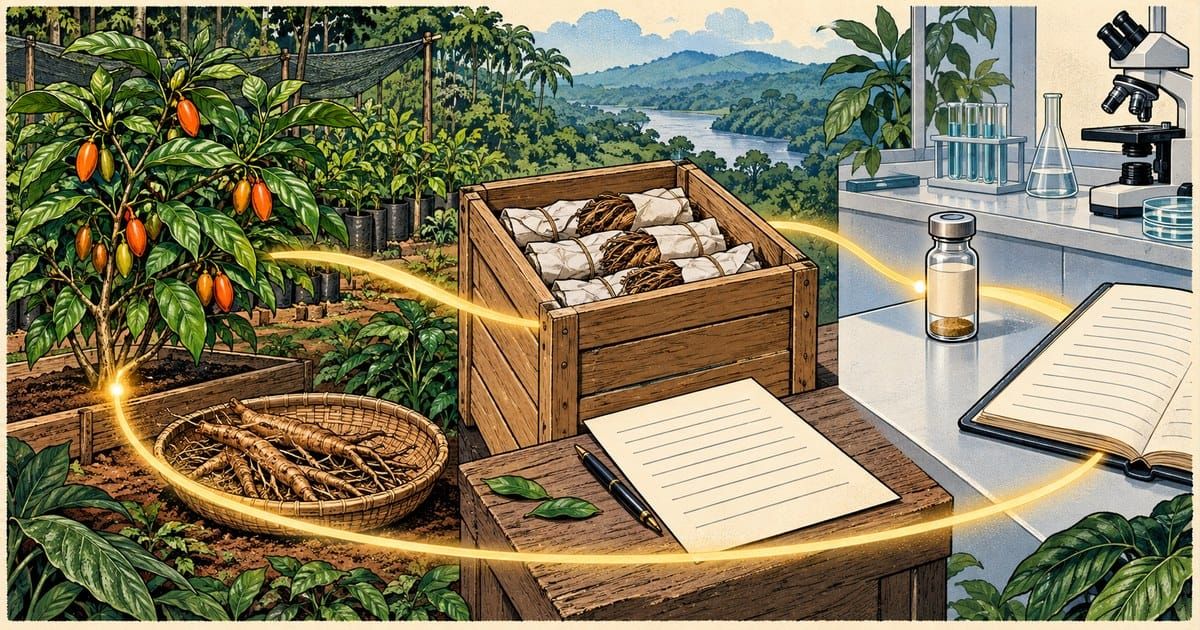
Buying the root is one transaction. Sharing what happens after the root leaves the village is another.
That distinction sits at the center of Molly Helfend's October 1 reporting for Mongabay. Iboga, Tabernanthe iboga, is a West-Central African plant whose root bark is important in several Gabonese Bwiti traditions. It is also the original source of ibogaine. [1]
Paid for the bark. Waiting for the rest.
Mongabay reports that A2E, an association of villages in Ogooué-Ivindo province, earned about $50,000 from three legal shipments of cultivated iboga between 2023 and early 2025. Its contractual share of later value had not arrived. The buyer says that money is held in trust pending government guidance. [1]
The same reporting describes Gabon's May benefit-sharing decree and September moves to halt exports while a national framework is developed. It reports that the interruption reaches the legal community trade, too. These are reported implementation conditions, not an independently verified account of every provision's legal effect. [1]
A receipt is not a share
The Nagoya Protocol provides an international framework for access to genetic resources and fair sharing of benefits from their use, including associated traditional knowledge. The Convention on Biological Diversity explains that benefits can include royalties, research collaboration and training, rather than money alone. [2]
Our reading of the dispute is that benefit sharing needs an address, a timetable and someone responsible for making it happen. A promise becomes useful when the intended recipients can establish what they are owed and how to challenge a missing payment.
There is also a difference between consultation with a government and participation by the communities involved. A national fund may be a way to distribute value. Its existence alone would not answer who makes the decisions or whether growers and traditional practitioners can see the accounts.
We have covered ibogaine as a research molecule. This follow-up starts earlier in its journey. It asks what a growing treatment industry owes to the people who cultivated the plant and maintained its knowledge.
The people at the beginning of that journey should be participants in the business, not acknowledgments at the end of a brochure.
— The Alkaloid
Sources
- Molly Helfend, Mongabay: Gabon wants a fairer share of the ibogaine boom — October 1, 2026; reported interviews and implementation account. No direct quotations reproduced.
- Convention on Biological Diversity: About the Nagoya Protocol — primary explanation of the international framework; does not establish Gabon's current implementation.
The Alkaloid publishes every Tuesday. Forward this to someone who needs the dose. Subscribe for full access: TheAlkaloid.com