The Alkaloid #31: The Leaf and the Label
Kratom leaf and concentrated 7-OH can share a name on the shelf without sharing a chemical profile. The distinction matters for safety, research and regulation.


Science, culture and capital — one dose at a time
The Dose
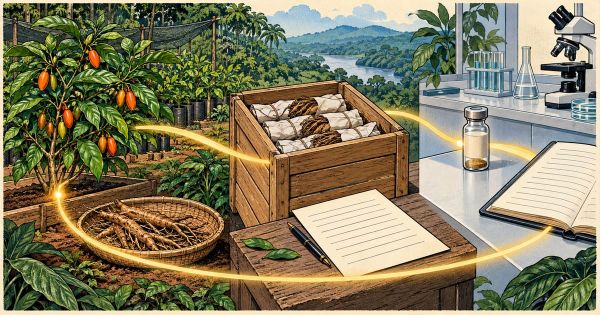
A leaf on a packet is a reassuring little graphic. It says nature was involved. It says remarkably little about what happened afterward.
That is the problem with calling every kratom-related product kratom. The name can describe a preparation of a Southeast Asian tree's leaves. It can also appear on products built around concentrated 7-hydroxymitragynine, usually shortened to 7-OH. The American College of Medical Toxicology describes these concentrated products as a departure from traditional leaf preparations, despite packaging that sometimes uses the same plant name. [1]
The distinction is chemical, not a contest between wholesome plants and sinister laboratories. A natural origin does not establish safety; a manufactured ingredient does not automatically establish danger. What matters is the substance, its quantity and the evidence about what it does.
This week's useful question is therefore more specific than whether kratom is good or bad. How far can a product move from the leaf before its familiar name stops helping the person buying it?
Quick Hits
- A finished order, for three compounds. DEA temporarily placed mitragynine pseudoindoxyl, MGM-15 and MGM-16 in Schedule I effective August 26, 2026. These are related substances, not interchangeable names for 7-OH. [2]
- A separate process for 7-OH. DEA's July notice proposed scheduling 7-OH above a specified threshold. HHS subsequently extended its threshold-information comment period to September 10. A notice of intent and a closed comment period do not, by themselves, establish an effective scheduling order. [3] [4]
- The clinical warning is explicit. ACMT reports overdose and death linked to concentrated 7-OH products, and dependence and withdrawal cases treated with medications for opioid use disorder. It calls for clinical research and measures against unrestricted nonprescription sales of opioid agonists. A professional position statement is a safety assessment, not a randomized trial. [1]
That's the news. The analysis is below — Science Desk, Market Watch, and a closing thought.
Science Desk
The ingredient and the exposure
Kratom is Mitragyna speciosa. FDA describes 7-OH as a minor naturally occurring constituent, comprising less than 2% of the leaf's total alkaloid content. That denominator matters: it is not a statement that leaves are 2% 7-OH by weight, nor a safe-dose recommendation. FDA has not approved kratom or its compounds as treatments. [5]
There is another wrinkle. Mitragynine can be metabolized into 7-OH. A human pharmacokinetic study published in 2024 measured both compounds after single and repeated doses of encapsulated dried leaf powder. Finding 7-OH after someone consumes a leaf preparation therefore does not, on its own, prove that they bought a tablet with added or concentrated 7-OH. [6]
Those distinctions make safety reporting harder, but more useful. We need to know what was actually taken rather than infer it from a brand name or a single laboratory result.
Potency needs a context
Opioid-receptor activity is relevant to these products, but a potency comparison from an animal assay is not a conversion chart for humans. It does not establish an equivalent consumer dose or a numerical overdose risk. FDA's 2025 scientific assessment also acknowledges uncertainty in adverse-event reports involving uncharacterized products, other medications and underlying illness. Those limitations do not erase the reports; they limit the conclusions we can draw from them. [7]
Our reading is that product identification should come before a sweeping headline. A report about concentrated 7-OH should say concentrated 7-OH. A report about a leaf preparation should identify that preparation. If the product is unknown, the uncertainty belongs in the story, not in a footnote the reader never sees.
Market Watch
The packaging is not the formulation
DEA's August order describes related synthetic products sold as powders, tablets and liquid shots, including marketing that presents them as botanical extracts or wellness products. Its concern includes the possibility that botanical branding creates a false impression of lower risk. [2]
FDA's 2026 explanation of the threshold process explicitly separates concentrated and synthetic products from natural leaves with trace levels of 7-OH. That is the intended scope of the action it describes, not a blanket endorsement of leaf products. [8]
For businesses, our view is that a useful label should do more than invoke the plant. It should identify the relevant compounds and quantities per unit, connect testing to the actual batch, and make the distinction between leaf material and a concentrated formulation easy to see. A beautiful certificate that cannot be matched to the packet is not much help at the checkout.
We covered label accuracy with CBD in Issue #21. The different question here is category identity: even a correctly measured ingredient can be misunderstood if the product's familiar name suggests something else.
Regulation should be able to distinguish formulations, too. Treating every preparation as identical makes it harder to communicate an accurate warning. Treating botanical ancestry as a safety exemption makes the opposite mistake.
The Last Word
People deserve better than a choice between reassurance from a leaf graphic and alarm from a nickname.
The first obligation is to tell them what the product is. The next is to explain what researchers know, what remains uncertain and why the distinction matters. That approach leaves room for sensible standards and care for people experiencing dependence, without making them props in a culture war.
A plant name is a beginning. It should not be the end of the ingredient list.
— The Alkaloid
Sources
- American College of Medical Toxicology: 7-hydroxymitragynine position statement — professional safety assessment, 2026.
- DEA temporary scheduling order — effective August 26, 2026; covers mitragynine pseudoindoxyl, MGM-15 and MGM-16.
- DEA notice of intent for 7-OH above a specified threshold — July 6, 2026; proposed action.
- HHS extension of threshold-information comment period — September 10 deadline.
- FDA and Kratom — agency background and regulatory position.
- Human mitragynine and 7-hydroxymitragynine pharmacokinetics after dried leaf powder — peer-reviewed human study, 2024; background, not new efficacy evidence.
- FDA scientific assessment of 7-OH — July 2025; evidence review.
- FDA: Hiding in Plain Sight — includes July 2026 process update.
The Alkaloid publishes every Tuesday. Forward this to someone who needs the dose. Subscribe for full access: TheAlkaloid.com