Field Notes #12: Beyond the Breakthrough Headlines
A new US survey records health changes people attribute to five psychoactive drugs. Its small subgroups and different recall windows matter as much as the headlines.

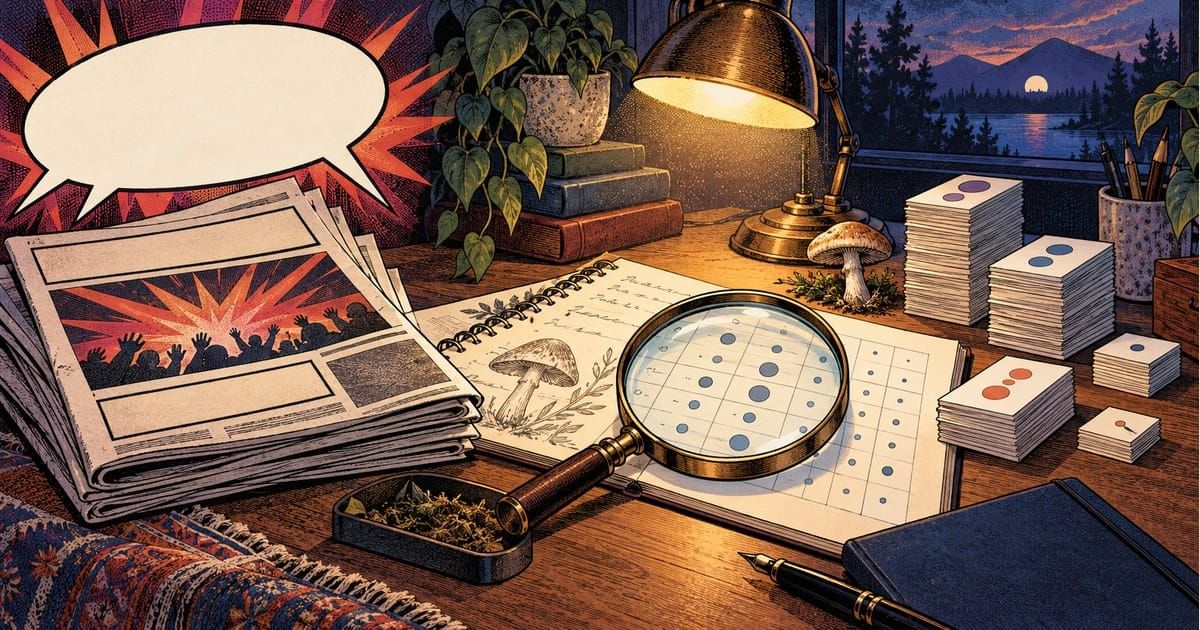
A careful clinical trial and an ordinary drug experience answer different questions. We need evidence about both, without pretending that one can stand in for the other.
A September 29 research letter in JAMA Network Open analyzes 2025 survey data from 1,964 adults reporting recent use. The past-year groups include 1,151 psilocybin users, but just 74 ibogaine and 95 5-MeO-DMT users. People could report more than one substance. The online panel was weighted against a nationally representative anchor survey. [1]
The number needs its denominator
The study found comparatively high self-attributed adverse outcomes for ibogaine and 5-MeO-DMT. These were respondents' accounts, not verified drug-caused diagnoses. Health changes and health care use covered 12 months; the symptom questions covered three months. The groups also differed in psychiatric history and substance co-use. [1]
Our interpretation is that the findings deserve attention without becoming a consumer safety league table. A percentage can look impressively precise on a screen while resting on a small group. Comparing percentages without comparing the people behind them gives the arithmetic more authority than it has earned.
A chart also cannot answer whether a clinic visit was an emergency just because it counted health care use. Readers should insist on the actual question asked before accepting a more dramatic description of the answer.
A reason to investigate
We covered trial design in Issue #23. This is a follow-up in the opposite direction: looking beyond a trial to people's reported experiences. It adds a different kind of evidence, rather than overturning everything that came before it.
Our editorial conclusion is to ask better follow-up questions. Which preparations were used? What happened before the drug was taken? What kind of care followed? Those details would help distinguish a safety problem from an attractive but unsupported explanation for one.
Taking an adverse experience seriously does not require treating every interpretation of it as settled. Good reporting can make room for the person and the uncertainty.
— The Alkaloid
Sources and disclosures
[1] Simonsson and colleagues, Adverse Health Outcomes of Psilocybin, LSD, MDMA, Ibogaine, and 5-MeO-DMT. JAMA Network Open, September 29, 2026. DOI: 10.1001/jamanetworkopen.2026.36756. Peer-reviewed cross-sectional research letter; descriptive analysis, not a randomized comparison.
Survey validation was funded by SAMHSA; ongoing collection by NIDA/NIH. Three authors work at Rocky Mountain Poison & Drug Safety, a surveillance and research provider. Peter Hendricks discloses outside grants, fees, equity, company cofounder roles and a pending patent involving pharmaceutical and psychedelic businesses. The paper lists the individual relationships. Disclosure does not establish influence on these findings.
The Alkaloid publishes every Tuesday. Forward this to someone who needs the dose. Subscribe for full access: TheAlkaloid.com