The Alkaloid #26: The 227 Smells of Cannabis
A new cannabis genetics paper cataloged 227 volatile terpenes across six cultivars. The fun part is what those compounds reveal about flower, genes, and why your nose keeps finding more than a THC label can say.


The paper counted 227 volatile terpene compounds, not 227 smells proven separable to the human nose. The fun part is what that chemical variety reveals about cannabis genes, flowers, and labels.
No hype, no moral panic. Just attention.
THE DOSE
Cannabis menus have spent years turning a living plant into two numbers: THC and price. Then somebody opens the jar.
Citrus. Pine needles. Pepper. Flowers. Damp earth. Fuel. Sometimes a fruit nobody has had the nerve to name.
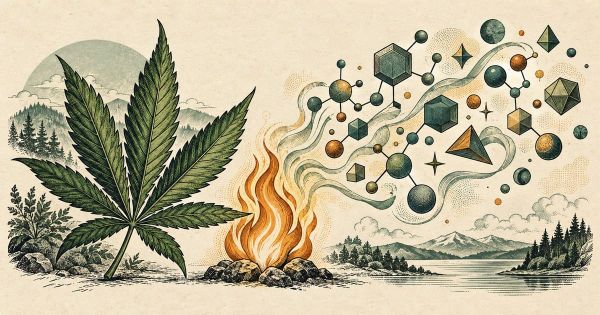
A new paper offers a look backstage. Researchers combined a haplotype-resolved cannabis genome with gene-expression data, chemical profiling, and enzyme tests. Across six cultivars and 28 tissue-and-development categories, they detected 227 volatile terpene compounds: 88 monoterpenes and 139 sesquiterpenes.[1]
That is where the headline needs an asterisk. The researchers found 227 compounds, not 227 separately verified smells. They did not run a human sensory panel. Still, the chemical census is remarkable, and it helps explain why "weed smell" has always been a category pretending to be a description.
The plant did not spread those compounds around evenly. Flowers and bracts carried the richest, most intense profiles. In the Dinamed Kush developmental series, the method detected one volatile terpene in roots and three in mature seeds.[1] The plant appears to save its peacock feathers for flowering.
There was a family resemblance across cultivars, but the cousins had opinions. The researchers found 33 core terpenes in all six cultivars and 60 that appeared in only one cultivar within this dataset.[1] Red Pure leaned toward beta-myrcene and terpinene. George Gloria stood out for guaiol and camphene. Dinamed Kush carried more caryophyllene and humulene.[1]
One especially neat example involved trans-beta-ocimene, a floral and herbal compound. Painkiller produced much less of it than the other five cultivars. Expression of the closest matching terpene-synthase gene was about 20-fold lower in Painkiller, too.[1] That does not prove a single gene controls an entire aroma. It does show the kind of gene-to-compound link breeders have wanted to see.
The genetic side was almost as busy as the chemical side. The team identified 56 putative terpene-synthase loci across the two Dinamed Kush haplotypes, then narrowed those to 41 high-confidence, full-length genes.[1] Six previously unreported enzymes were tested in engineered E. coli. Some accepted more than one precursor or produced several terpene products, which makes them less like one-purpose switches and more like tiny scent multitools.[1]
If this were the usual cannabis marketing story, somebody would now assign each compound a mood, an ailment, and a small watercolor icon. The study did none of that. It tested biosynthesis, not therapeutic effects, and it offered no proof for an entourage effect.[1]
It also did not settle what people actually smell. Terpenes can dominate a lab report without dominating the nose. A 2023 peer-reviewed study of 31 cannabis rosin extracts found that products with similar major-terpene profiles could smell quite different. A seven-person, untrained sensory panel linked some of that variation to low-concentration sulfur compounds and other nonterpenoid volatiles associated with citrus, tropical, sweet, savory, chemical, and skunky notes.[2]
That supporting study deserves a bright yellow disclosure sticker: Abstrax Tech funded it, most of its authors worked in the company's research and development group, and several filed patents related to the findings.[2] The work is useful, but the commercial interest is part of the evidence, not a footnote to hide.
Put the two papers together carefully and a more interesting picture appears. Cannabis aroma is partly genetic, strongly shaped by tissue and development, and chemically too busy for a short list of familiar terpenes to explain on its own. A lab panel is a useful map. It is not a scratch-and-sniff oracle.
QUICK HITS
California changed the format, not the head count
California researchers analyzed survey responses from 178,836 adults collected between 2017 and 2024. Past-year cannabis use was statistically stable, moving from 22.1% in 2017 to 23.5% in 2024. How people consumed it changed more: among past-month consumers, combustible use fell from 71.2% in 2019 to 58.1% in 2024, while edible use rose from 40.3% to 53.6%.[3] The survey cannot prove legalization caused the shift. Still, California's statewide picture looks less like "everybody uses cannabis now" and more like "somebody brought gummies." The work received public funding; lead author Jamie Corroon disclosed compensated board membership at CBD company CV Sciences, which the paper says had no role or knowledge of the study.[3]
Berlin put legalization in the museum
For Berlin's Long Night of Museums on August 29, the Hanf Museum invited visitors to contribute personal stories about cannabis legalization for a video installation.[5] In a separate announcement, the museum said artist Felix Almes would turn its facade into a temporary work about intoxication, prohibition, and cannabis culture.[7] Laws preserve dates and clauses. Museums get the awkward conversations, changed friendships, and things people once kept quiet.
Under psilocybin, the brain followed the room
In a Nature study, 62 psychedelic-naive adults moved through rest, guided meditation, music, and a film after a 19-milligram psilocybin dose. Machine-learning analyses found brain activity organized more clearly around the surrounding context under psilocybin.[4] The study was open-label, had no placebo, and used a fixed task order, so it is not the final word. Several authors disclosed current or former psychedelic-industry affiliations.[4] It is still a striking bit of evidence that "set and setting" may leave a measurable fingerprint rather than serving only as good advice printed on the retreat brochure.
SCIENCE DESK
A compound count is not a smell test
The 227 figure came from non-targeted gas chromatography-mass spectrometry, or GC-MS. The instrument separates volatile compounds and compares their spectra and retention behavior with reference libraries. The researchers manually curated the matches, confirmed selected compounds with authentic standards, and performed absolute quantification for 22 target terpenes.[1]
That is careful chemistry. It still leaves three useful limits.
First, many of the 227 compounds were tentatively identified rather than confirmed one by one against purified standards. Second, detection says a compound is present; it does not say a person can smell it at that concentration. Odor thresholds vary enormously. A trace compound with a very low threshold can boss around a far more abundant neighbor.[2]
Third, the main study used six cultivars and centered its gene map on Dinamed Kush. The enzyme tests happened in engineered bacteria, not in a cannabis plant with a gene selectively switched off. The results support a connection among gene sequence, gene expression, and terpene output. They do not make cultivar aroma fully predictable.
The best way to read this paper is as a map of biosynthetic possibility. It shows where volatile terpenes accumulated, how the profile changed across development, and which genes produced which classes of molecules in the study's test systems. The human nose gets the final vote, and this experiment did not invite it into the room.[1]
MARKET WATCH
The lab label is about to get crowded
Routine cannabis certificates of analysis usually present a short terpene list.[6] In a recent Cannabis Business Times essay, horticulturist Craig Hartsough put the common range at roughly 12 to 30 compounds.[6] The new research paper found 227 through much broader, non-targeted profiling.[1]
Those numbers are not an apples-to-apples contest. A targeted commercial panel is designed to measure a chosen set consistently. A research team looking for unfamiliar compounds has a different job. Nobody needs a 227-row sticker on a pre-roll tube.
The gap does point to a business opportunity. Breeders, testing labs, and flavor companies can build better aroma maps by looking beyond the usual major terpenes. That may mean adding sulfur compounds, esters, alcohols, aldehydes, and other low-concentration volatiles that standard panels miss.[2][6]
The risk is familiar: marketing can outrun measurement before the chromatograph has cooled down. A richer panel could help explain cultivar differences and catch processing losses. It cannot tell a customer exactly what they will smell, much less how they will feel. The companies that keep those sentences separate will be doing everyone a favor.
THE LAST WORD
THC gets to be a number. Aroma insists on becoming a conversation.
The new study does not give the world 227 new wellness claims, and thank goodness. It gives us a better look at how a plant builds chemical variety: genes provide instruments, development adjusts the volume, and a human nose hears the result.
The next time a jar smells like citrus peel, pepper, pine, flowers, fuel, and something suspiciously close to a tropical candy shop, there is no need to force it into one tidy category. The plant declined the assignment first.
Until next week, stay curious, stay grounded.
Sources
- Mi et al. 2026 — cannabis terpene synthase map
- Oswald et al. 2023 — minor nonterpenoid aroma compounds
- Corroon et al. 2026 — California cannabis use methods
- Stoliker et al. 2026 — psychedelics align brain activity with context
- Hanf Museum Berlin — legalization stories exhibition
- Cannabis Business Times — limits of routine terpene panels
- Hanf Museum Berlin — Felix Almes: Rausch als Form