The Alkaloid #25: The Deadline That Hasn't Moved
Everyone reported that the federal hemp ban slipped to December 11. It hasn't passed the House, and the delay is narrower than the coverage suggests: it turns on whether a molecule is capable of being naturally produced, not on how it was actually made. What that sorts, and what it strands.

THE DOSE
The Deadline That Hasn't Moved
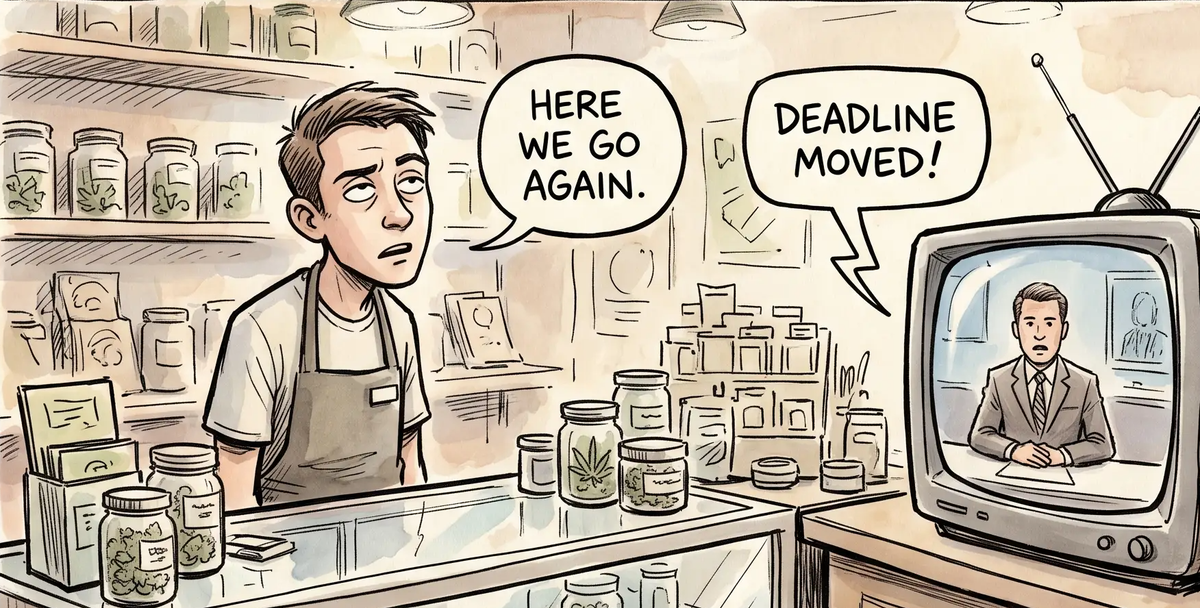
If you sell hemp products, you spent the last two weeks reading that the federal ban got pushed to December 11. The trade press ran it. Distributors emailed it to their accounts. Retailers rebuilt their sell-through math around the extra month.
The delay is real. It also hasn't passed, and it doesn't do what most of the coverage says it does.
It isn't law. The Senate passed H.R. 6500 at 3:37 in the morning on August 8, by a vote of 90 to 6. That bill started life as the AGOA Extension Act, an Africa trade measure the House passed in January, which the Senate then hollowed out and used as a shell for a continuing resolution. The House has its own CR, H.R. 9770, passed in July, funding the government through December 4 and containing no hemp language at all. Two chambers, two spending bills, two different end dates, no agreement. Until they reconcile and the President signs, Section 781 takes effect November 12. That is still the operative date in federal law today.
The House returns August 31 for a short week running through September 3. Funding runs out at midnight on October 1. Hemp is not the reason anybody is at that table.
The delay is also narrower than it sounds. Section 2019 of the Senate bill does not delay Section 781 across the board. It delays it only for cannabinoids capable of being naturally produced by the cannabis plant. Read that as a chemical test, not a manufacturing one. It asks what the molecule is, not where it came from.
Delta-8 is a molecule the plant can make. It makes almost none of it, which is why essentially all shelf delta-8 is produced by chemically isomerizing CBD in a lab. Under Section 2019 that inventory rides along to December 11 anyway, because the statute asks whether the plant could in principle produce delta-8, and it could. The American Trade Association for Cannabis and Hemp objected on exactly that ground, arguing the drafting was deliberate and leaves the CBD-to-delta-8 conversion route open for another month.
What loses hemp status on November 12 is the narrower set regulators are expected to treat as not naturally producible. HHC. THC-O and its relatives. The analogs that were only ever going to come out of a reaction vessel. Expected is the operative word: FDA and HHS still owe the definitive list of which cannabinoids the plant counts as capable of producing, so the line between the two buckets is a reading of the statute rather than a settled roster.
So the delay everyone described as a reprieve for the hemp industry is more specific than that. It is a reprieve for the conversion economy, and a hard stop for the analog shelf, and it hasn't passed.
December 11 isn't a finding about anything. Nobody calculated how long reformulation takes, or how long the FDA needs to write a rule. December 11 is the date the Senate's continuing resolution runs out of money. The House's version says December 4. The hemp deadline got stapled to an unresolved spending fight, which is exactly how it got here in the first place.
The vote doesn't sort the way you'd expect, either. Sen. Ted Budd of North Carolina offered an amendment to strip the delay and hold the November date. He had fourteen cosponsors, among them Mitch McConnell, Chuck Grassley and Kirsten Gillibrand. Sen. Amy Klobuchar moved to table it and won, 61 to 32. Axios reported that President Trump called Budd about the amendment to lay out why the White House wanted the delay; Marijuana Moment later reported a Budd spokesman saying no explicit request to drop it was made. Budd led with a procedural objection rather than a moral one. His argument was that an extra month is not for writing policy, it is for jamming the Senate in December on another must-pass package, and he separately faults the industry for products he says are made to appeal to children. Klobuchar argued the delay buys time for a durable solution instead of letting a federal ban wipe out an industry that is currently working, citing $16 million in Minnesota state tax revenue last year and the farmers, brewers and small businesses behind it.
Both of them are describing something real. That's the trouble with this fight. It has never once been held as a debate about hemp.
QUICK HITS
Arrests went up. The FBI released its 2025 national crime statistics on August 14, logging 218,152 marijuana arrests, a 7 percent rise over 2024's 204,036. Of those, 200,960 were possession only. Reporting to the program is voluntary, covers roughly 96 percent of the population, and counts enforcement actions rather than individual people.
Gallup has smoking at a record, sort of. Fielded July 1–19 and released August 24: 17 percent of U.S. adults say they smoke marijuana, matching the 2023 high. Fifteen percent report edibles. Cigarettes sit at 11 percent, matching the low set in each of the last two years. The 30-to-49 bracket leads at 25 percent. Sample of 1,200, margin of error ±4 points, which is wide enough that tying a record is not the same as setting one.
DEA published the hearing transcript. About 2,500 pages from the eleven-day rescheduling hearing in front of Chief ALJ Derek Julius, with government attorneys on record arguing that marijuana can no longer be justified in Schedule I. Julius ordered 294 corrections and set today as the deadline for the amended version. What comes next is his recommended decision, then a final rule from the Administrator. The proposed rule has been sitting there since May 2024, and no deadline applies to either remaining step.
Illinois expanded its medical list. The state Department of Public Health added sickle cell disease and polyendocrine metabolic ovarian syndrome with chronic pain, effective August 25, bringing the qualifying list to 58 conditions.
Ohio keeps climbing. $777 million in combined medical and adult-use sales between January 3 and August 21, up 28 percent year over year, on $4.15 billion all-time.
That's the news. The analysis is below — Science Desk, Market Watch, and a closing thought.
SCIENCE DESK
What 0.4 Milligrams Actually Measures
Section 781 changed two separate things, and they get talked about as if they were one. It changed what gets counted. It also changed how much is allowed.
The 2018 Farm Bill defined hemp with a single number: not more than 0.3 percent delta-9 THC by dry weight. One molecule, measured on the plant. Section 781 swaps that for a total-THC standard applied to the finished product in the customer's hand.
Total THC is a defined term with a formula behind it. Under USDA's rule at 7 CFR 990.1, it's what you get after decarboxylation, or, if the lab uses liquid chromatography instead of heat, from this:
Total THC = (0.877 × THCA) + THC
The 0.877 is a mass ratio. THCA carries a carboxyl group that falls off as carbon dioxide when heated, leaving THC behind. The acid weighs more than what it turns into, so you multiply down to get the potential.
That one conversion closes the THCA flower loophole. THCA flower tests under 0.3 percent delta-9 in the jar and becomes ordinary high-THC cannabis the second someone lights it. USDA has used a post-decarboxylation standard on pre-harvest crop testing for years. The loophole lived in the statute, which defined the finished product by delta-9 alone, and Section 781 closes the gap between the two.
The threshold is the sharper edge. Four tenths of a milligram is a per-container limit, not a per-serving one. A ten-count package of 5 mg gummies holds 50 mg, about 125 times the cap. A single low-dose seltzer at 2 mg is five times over. Nobody can formulate an intoxicating product that clears 0.4 mg per package, so at that level the number stops working as a ceiling and starts working as a ban with a decimal point in it.
The industry's objection to that is fair. So is the objection it's answering. Congress in 2018 wrote a definition around one molecule and the market spent seven years finding the others. Delta-8, HHC and THCP ended up in gas stations in states whose voters had never approved anything of the kind, often with no age gate and no testing requirement. Something was going to close. Whether a threshold nobody can meet counts as a rule is the argument worth having, and Congress hasn't held it.
MARKET WATCH
Whitney Economics puts the hemp-derived cannabinoid market at $47.3 billion to $64.1 billion in 2025 under its higher estimate, and $37.5 billion to $50.9 billion under its conservative one. Either way it is up sharply from $28.4 billion in 2023. The same work counts 375,000 to 473,000 jobs and more than $13 billion in wages. Across Florida, Texas, Illinois, Tennessee and North Carolina, hemp retailers went from 16,669 to 22,590 between 2023 and 2025, though almost all of that growth is Texas, Tennessee and North Carolina. Florida and Illinois shrank.
Two estimates that far apart, and a low end and a high end inside each, tells you something by itself. Nobody can size this market precisely because most of it operates in a legal space that was never built to hold it.
The licensed side, meanwhile, is consolidating. Curaleaf announced its intention to bid for Aurora Cannabis on August 11 at $4 per share, 75 cents of it cash and the rest in Curaleaf stock, worth about $272 million at the time. Aurora jumped 22 percent to $3.48. Curaleaf formally launched the offer on August 18, by which point its own stock had moved and the deal was being valued closer to $260 million, and it runs until December 1. Aurora formed a special committee of independent directors, has told holders to take no action pending its formal circular, and has spent the last week publicly disputing Curaleaf's characterizations of its business. Chairman and CEO Boris Jordan pitched the combination as a company operating across 17 countries with more than $1.5 billion in trailing revenue and over 50 tons of EU-GMP cultivation capacity.
Read those two items together and the money is saying something. A U.S. multistate operator is buying international cultivation while the fastest-growing domestic channel sits on a shutdown date. The tax picture points the same way. State-licensed medical cannabis moved to Schedule III back in April, and Treasury set January 1 of this year as the effective date for 280E relief on the eligible portion. Adult-use operators are still paying it, which is what the broader rescheduling proceeding would change. Hemp gets nothing from any of it, because 280E only reaches Schedule I and II substances and hemp sits outside the Controlled Substances Act entirely. Capital is not betting on the hemp shelf.
THE LAST WORD
Notice how the date moved, not that it moved.
Section 781 arrived inside the spending package that ended the shutdown in November 2025. Not as a hemp bill. As Section 781. The delay arrived inside another spending bill nine months later, at 3:37 in the morning, drafted tightly enough that the survivors and the casualties were sorted by a chemical definition most people reading the coverage will never see. Neither one was ever argued on its own terms. Both rode.
What that leaves is a shop owner in Chicopee or Amarillo reading appropriations text to work out whether the inventory in the back room is legal in ninety days, and then reading a subclause of the Agricultural Marketing Act to work out which half of it. That is what happens when a consumer category gets regulated exclusively through funding deadlines. It lands hardest on the people with the least capacity to track it.
Two bills exist that would put an actual framework where the threshold is. Reps. Andy Barr and Angie Craig have the Lawful Hemp Protection Act, which would separate industrial hemp from consumable hemp and direct the FDA to set cannabinoid limits. Reps. Beth Van Duyne and Greg Landsman have a narrower one that would let hemp beverages carry 5 mg per twelve-ounce serving under TTB permits, the same agency that handles alcohol. Neither has moved.
Twenty-nine days buys time for a hearing nobody has scheduled.
And until the House votes, there aren't twenty-nine days. There's November 12.
— The Alkaloid
Sources
- H.R. 6500 as passed by the Senate, Section 2019 (full text)
- 7 U.S.C. 1639o, definition of hemp and the cannabinoid subclauses
- U.S. Senate Roll Call Vote 228, 119th Congress (H.R. 6500, August 8, 2026)
- Congressional Record, August 7, 2026 (Budd amendment debate)
- Marijuana Moment — Senate Votes To Delay Hemp Ban
- Axios — Inside the GOP hemp wars
- Sen. Klobuchar — Senate Passes Delay of Hemp Ban
- Cannabis Business Times — Senate Votes to Delay Intoxicating Hemp THC Product Ban
- House Appropriations Committee — House Passes H.R. 9770
- Akin — Congress Returns from August Recess
- Arnold & Porter — Major Changes to Federal Regulation of Hemp-Derived Products
- eCFR, 7 CFR 990.1 — Domestic Hemp Production Program, Meaning of Terms
- Rep. Barr — Lawful Hemp Protection Act
- Rep. Van Duyne — Beverage Regulatory Parity Act
- FBI — 2025 Reported Crimes in the Nation Statistics
- The Marijuana Herald — More Than 218,000 Marijuana Arrests Reported in 2025
- Gallup — U.S. Marijuana Smoking at Record High, Cigarettes at Low
- Illinois Department of Public Health — Two New Conditions Now Eligible
- The Marijuana Herald — Ohio Marijuana Sales Reach $777 Million
- The Marijuana Herald — DEA Releases Rescheduling Hearing Transcripts
- Federal Register — Schedules of Controlled Substances: Rescheduling of Marijuana
- Gibson Dunn — DEA Downschedules State Medical Marijuana to Schedule III
- MJBizDaily — Curaleaf Advances Hostile Takeover of Aurora
- MJBizDaily — Curaleaf Plots $272 Million Hostile Takeover of Aurora Cannabis
- Whitney Economics 2026 hemp report, via Crescent Canna
The Alkaloid publishes every Tuesday. Forward this to someone who needs the dose. Subscribe for full access: TheAlkaloid.com