Field Notes #2: Five Years in the Gray Market
Virginia just vetoed the bill that would have launched legal cannabis sales. The political story is small. The larger one — five years of legal possession without legal sales has produced the country's most documented case of what gray markets actually cost.

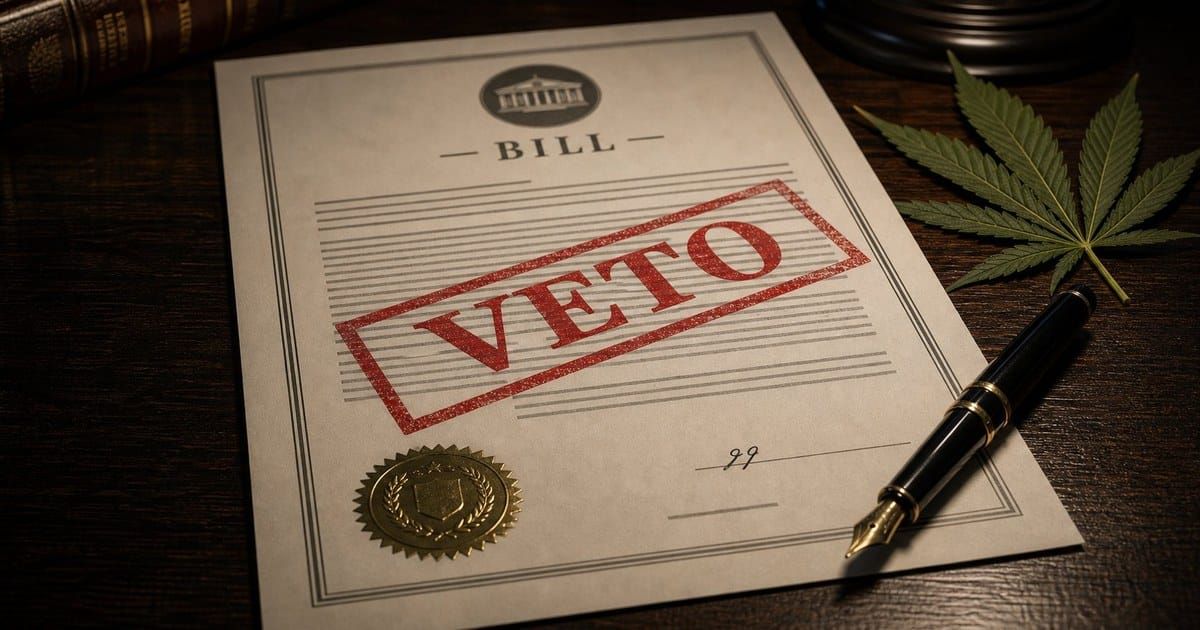
On Tuesday, Virginia Governor Abigail Spanberger vetoed HB642 and SB542, the bills that would have launched a regulated retail cannabis market in the Commonwealth. The headline coverage focused on what you'd expect: a Democratic governor blocking a Democratic legislature's signature bill, sharp statements from sponsors Sen. Lashrecse Aird and Del. Paul Krizek, and the inevitable promise that the fight resumes in 2027.
But the political story is the smaller story. The larger one is what Virginia has been running for five years now — and what we've learned about what happens when a state legalizes cannabis possession without legalizing cannabis sales.
Virginia legalized adult possession and home cultivation in July 2021. Adults over 21 can possess up to one ounce of cannabis, grow up to four plants at home, and gift small quantities between adults. What they cannot legally do is purchase it. There is no retail framework, no licensing system, no tested products, no taxation, no oversight. Just possession.
The result is the longest-running natural experiment in cannabis policy in the country.
What the gray market actually looks like
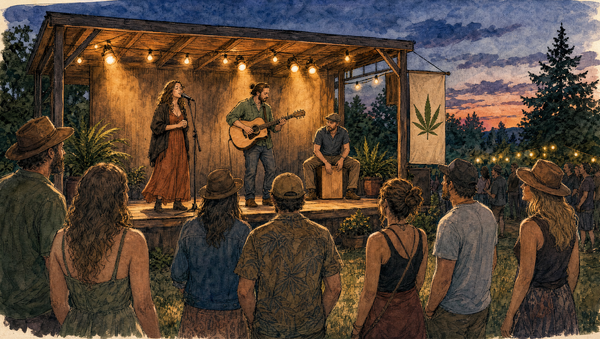
The Virginia Cannabis Control Authority — the agency that would have run the retail program — estimates the unregulated cannabis market in Virginia operates at over $2 billion annually. That's not from licensed operators. That's from gas stations selling unlabeled gummies, vape shops with handwritten THC menus, hemp-derived delta-8 products that exist in a federal loophole, gifting schemes ("buy this t-shirt, receive a free quarter ounce"), and a fully functional illicit distribution network that exists because demand has nowhere legal to go.
Michelle Peace, a forensic science professor at Virginia Commonwealth University who has studied unlicensed cannabis testing, has documented products containing mold, pesticides, heavy metals, and THC concentrations several times higher than labels claim. Emergency departments in Richmond and Northern Virginia have reported increasing cases of acute cannabis intoxication tied to products consumers believed were one strength and turned out to be another.
The 2021 legalization law was supposed to be the first half of a two-step process. The second half — retail framework — never happened. Then-Governor Glenn Youngkin vetoed it twice. Now Spanberger has vetoed it once, despite campaigning on the opposite position.
Five years in, "legalization" in Virginia has produced almost none of the benefits its advocates promised: no tax revenue (estimated at $400 million annually once the market matures), no consumer safety regulations, no equity provisions for communities harmed by prohibition, no displacement of the illicit market. What it has produced is everything advocates warned against: an unregulated commercial market that operates openly, serves consumers who have no other option, and answers to no one.
The public health argument the governor missed
Spanberger's stated reason for the veto was implementation readiness. The bill lacked sufficient regulatory infrastructure, she argued. The state needed more enforcement tools, clearer testing standards, longer rollout timelines.
This is the standard caution-first frame, and on paper it sounds reasonable. The problem is what it ignores. A 2024 National Academies of Sciences, Engineering, and Medicine report on cannabis policy was explicit about the public health risks of partial legalization: when a state legalizes use but not sales, the unregulated market doesn't shrink — it grows to fill the gap. Products become less safe, not more. Youth access often increases rather than decreases. Tax revenue that could fund prevention, treatment, and enforcement disappears entirely.
Virginia is now the country's most documented case of this dynamic in action.
The bill Spanberger vetoed would have created licensing for growers, processors, and retailers; mandated product testing; established THC caps (10mg per serving, 100mg per package); required child-resistant packaging; funded enforcement against illicit operators; and earmarked equity provisions for applicants from communities disproportionately affected by past enforcement. It was the result of years of work by a joint legislative commission specifically designed to learn from other states' rollouts.
The choice on the governor's desk wasn't between a regulated market and no market. It was between a regulated market and the gray market that already exists.
What happens next
The 2026 session is over. The next opportunity for retail legislation is January 2027. The General Assembly could attempt a veto override, but it would require two-thirds support in both chambers — a threshold the original bills did not reach. So the most realistic path is starting over next year, with another round of negotiations, another set of amendments, another opportunity for a veto.
In the meantime, Virginia continues to run the experiment. The gray market keeps growing. The data keeps accumulating. And the question the rest of the country should be paying attention to is not who's to blame for this veto, but what we're learning about what happens when policymakers can agree that cannabis should be legal — but cannot agree on what legal should mean.
Five years in, Virginia has given us the answer.
Sources
Office of the Governor of Virginia, Veto Statement on HB642 and SB542, May 19, 2026
Marijuana Moment, "Virginia Governor Vetoes Marijuana Sales Legalization Bill After Lawmakers Rejected Her Amendments", May 19, 2026
Virginia Mercury, "Spanberger vetoes cannabis bill, stalling legal sales again", May 19, 2026
The Washington Post, "Virginia marijuana legalization bill vetoed by Gov. Abigail Spanberger", May 19, 2026
Axios Richmond, "Gov. Spanberger vetoes Virginia retail marijuana sales bill", May 19, 2026
WTVR CBS 6, "Governor Spanberger vetoes legal retail marijuana market in Virginia", May 19, 2026
NORML, "Virginia Governor Vetoes Legislation Regulating Adult-Use Marijuana Sales", May 19, 2026
Virginia Cannabis Control Authority — illicit market estimates and public health statements
National Academies of Sciences, Engineering, and Medicine, Cannabis Policy Impacts Public Health and Health Equity, 2024
WHRO Public Media, "A retail cannabis market is nearly a done deal in Virginia" — Michelle Peace, VCU forensic science research on unregulated cannabis products, February 10, 2026