The Alkaloid #18: The Trip Is Optional
What if the trip was never the point? A new class of compounds promises the brain-rewiring of psychedelics without the hallucination, and the first non-tripping antidepressant is heading for trials you can run from your own couch.
The Dose
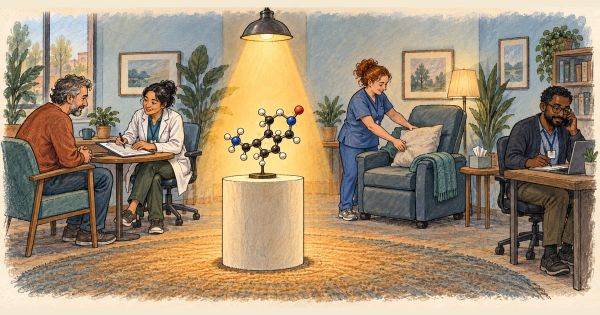
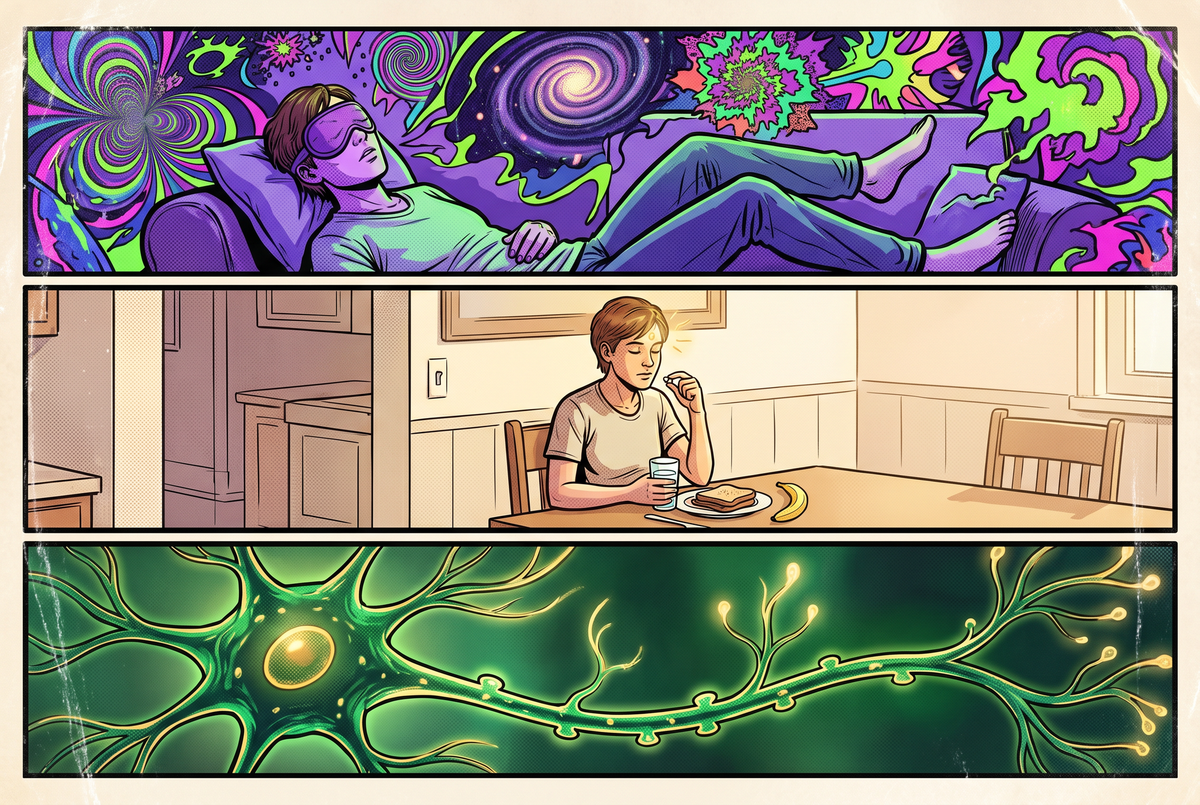
For a decade the promise of psychedelic medicine came bundled with an eight-hour ride, a guide, an eye mask, and a bill the size of a used car. The pitch was that the trip and the healing were inseparable, that you had to go through the experience to earn the benefit. A growing group of chemists thinks that is backwards. They have built molecules that rewire the brain the way psychedelics do while leaving the hallucination behind, and the first of them just cleared the FDA for trials people can run from their own couch.
Science, culture and capital — one dose at a time.
Quick Hits
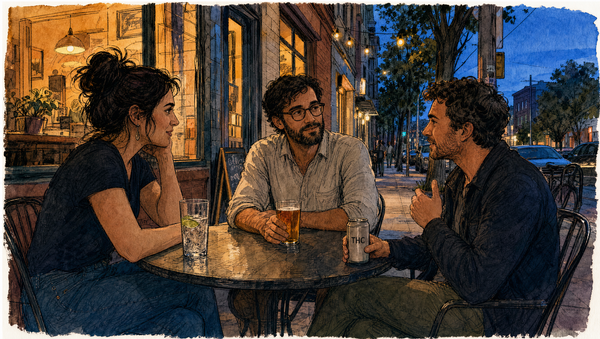
Booze is having an off decade. Low-dose THC drinks are now the fastest-growing category in cannabis, climbing as U.S. alcohol consumption slid to its lowest in nearly 90 years, according to Gallup. The sober-curious crowd is quietly swapping the cocktail for a 2.5-milligram seltzer.
Mushroom coffee mania. "Mushroom coffee" pulls hundreds of thousands of searches a month, with lion's mane and reishi promising focus and calm. The marketing is running comfortably ahead of the evidence, which is exactly the reason to keep an eye on it.
The room, standardized. A new framework in Nature Medicine, called ReSPCT, is the first serious attempt to pin down which parts of "set and setting" actually shape a psychedelic trial, arriving just as another camp argues the experience may not be necessary at all.
That's the news. The analysis is below — Science Desk, Market Watch, and a closing thought.
Science Desk
The idea has a clunky, wonderful name: psychoplastogens. Coined in David Olson's lab at UC Davis, now the Institute for Psychedelics and Neurotherapeutics, the word covers any molecule that rapidly promotes the kind of structural brain growth psychedelics are known for. The whole project is to keep that growth and drop the hallucination.
The growth in question is neuroplasticity, and specifically the sprouting of dendritic spines, the tiny nubs where one neuron reaches out to wire itself to another. In depression and chronic stress these connections wither, especially in the prefrontal cortex, and a single dose of a classic psychedelic can regrow them with surprising speed. So can Olson's non-hallucinogenic analogs: tabernanthalog, a cleaned-up cousin of ibogaine, and zalsupindole, a relative of the toad-derived 5-MeO-DMT.
For years the working assumption was that the trip and the rewiring were the same event, two expressions of the 5-HT2A serotonin receptor firing. New work from Olson's group, published in Nature Neuroscience, complicates that tidy story. The non-hallucinogenic compounds grow spines without triggering the glutamate surge and the burst of gene activity that scientists had assumed were required. The brain, it turns out, seems to have more than one door into plasticity, and at least one of them does not open onto a kaleidoscope.
If that holds, it cleaves psychedelic medicine into two philosophies. One says the experience is the medicine, the vivid, frightening, meaningful thing that reorganizes a life. The other says the experience is a side effect, real but optional, and the therapeutic work is quietly molecular. In practice it is the difference between a supervised daylong journey and a tablet you take with breakfast.
Market Watch
Capital finds the tablet version very attractive, for deeply unglamorous reasons. A drug that skips the eight-hour guided session also skips the clinic, the monitor, and most of the cost, which turns it into something a health system can actually deploy at scale. Delix Therapeutics is the clearest test case. Its lead compound, zalsupindole, known as DLX-001, is an oral 5-MeO-DMT analog, and in an early trial it produced an 11.6-point drop on the standard depression scale by week eight, roughly a 50% improvement, still holding four weeks after the last dose, with no hallucinations or dissociation reported. This year the FDA cleared a Phase 2 built around at-home self-administration. For a psychedelic-derived drug, letting patients dose themselves at home is a small revolution. The wager is blunt: an antidepressant with the upside of a psychedelic and none of the logistics is worth a great deal more than one that needs a spare room and a sitter.
The Last Word
There is a real loss tucked inside the convenience. For many people the psychedelic experience is not incidental at all; the awe and the fear and the flood of meaning are precisely what they credit for changing them. Strip that away and you may be left with something closer to a very good SSRI, useful and forgettable. And yet there is a quiet justice here too. Most people who could benefit from this kind of medicine will never see the inside of a boutique clinic or sit with a trained guide. A pill that works on an ordinary Tuesday, no journey required, is how a breakthrough turns into a treatment. Whether the soul was ever really in the molecule is a question worth sitting with.
No hype, no moral panic. Just attention.
— The Alkaloid
Sources
- Nature Neuroscience — Olson lab on the neuroplasticity mechanism of non-hallucinogenic analogs
- UC Davis Institute for Psychedelics and Neurotherapeutics; David E. Olson
- Delix Therapeutics — DLX-001 (zalsupindole) Phase 1b results and FDA Phase 2 clearance (2025–2026)
- ReSPCT set-and-setting guidelines, Nature Medicine
- Gallup on U.S. alcohol consumption; low-dose cannabis beverage market data
- Genetic Engineering & Biotechnology News — shared neuroplasticity pathway