The Alkaloid #19: The Strain That Was a Species
For years, home growers prized a potent magic mushroom called Natal Super Strength. Nobody had ever named it. New DNA work shows it is a separate species, and its family tree pushes the origins of the world's favorite psychedelic mushroom back more than a million years.
The Dose
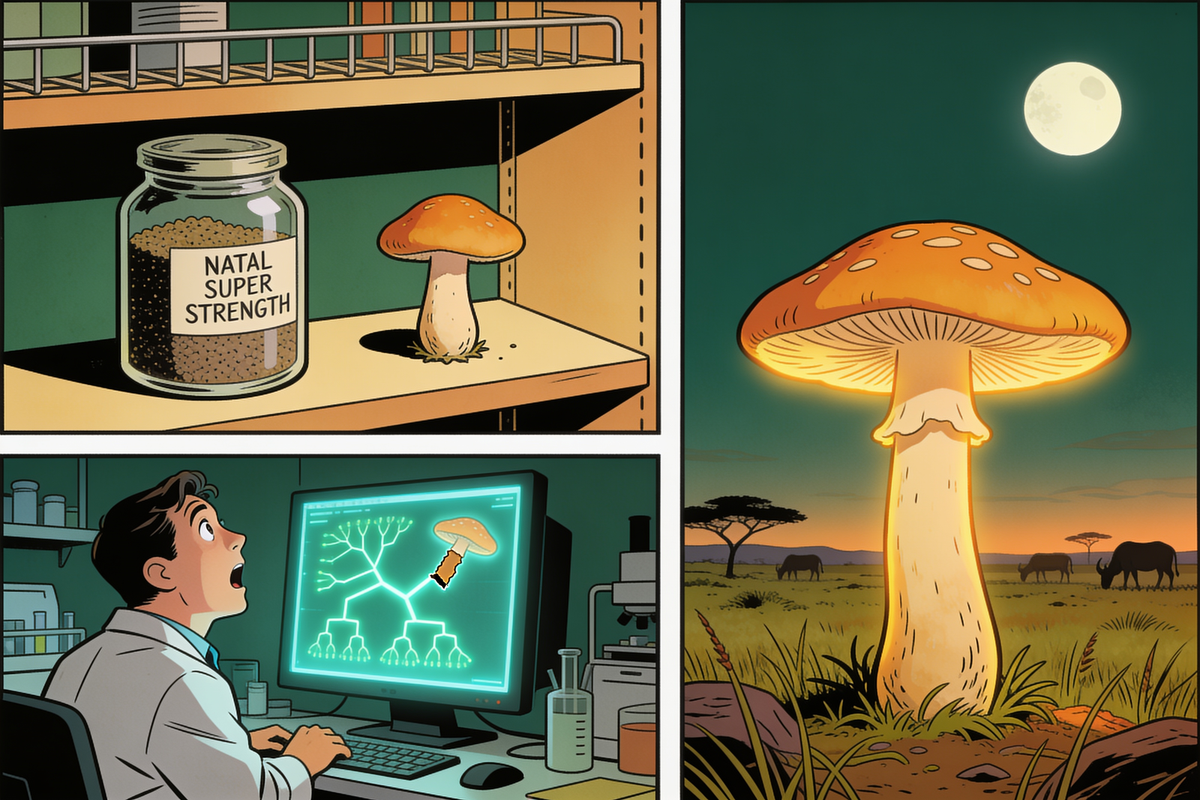
Somewhere on a shelf of spore syringes, filed between the exotic and the reliable, sits a mushroom that growers have trusted for years. They know it as Natal Super Strength, or sometimes Transkei. It is potent, it is forgiving to cultivate, and it has a small cult following among people who like their psilocybin a little stronger than average. What none of them knew, until a graduate student in South Africa ran its DNA, is that they had been growing a mushroom science had never formally named.
That mushroom is now called Psilocybe ochraceocentrata, and it is not a variety of the world's most famous magic mushroom after all. It is a species of its own. The finding, published in Proceedings of the Royal Society B, does something quietly radical along the way: it pushes the family history of Psilocybe cubensis back more than a million years and unsettles a tidy story about how these mushrooms spread around the planet.
Science, culture and capital — one dose at a time.
Quick Hits
- Five psychedelics, one fingerprint. An international team led out of McGill pooled more than 500 brain scans from 267 people across eleven datasets, the largest analysis of its kind. Psilocybin, LSD, mescaline, DMT, and ayahuasca all left the same signature: connections inside brain networks loosened, and traffic between networks that normally keep to themselves jumped. Different molecules, one shared effect, published in Nature Medicine.
- The molecule you never feel. In Science Advances, researchers reported that DMT, of all things, helped the brain weather a stroke in animals, sealing the blood-brain barrier and calming inflammation through the sigma-1 receptor. The doses were sub-psychedelic, low enough to skip the visions entirely. Human trials are next.
- The minor leaguers deliver. CBN and THCV, two cannabinoids that rarely make the label, cut inflammatory pain in preclinical tests, adding to the case that the plant's quiet compounds may do real work the famous two never got credit for.
That's the news. The analysis is below — Science Desk, Market Watch, and a closing thought.
Science Desk
The detective work started with a mismatch. Across the cattle-grazed grasslands of South Africa and Zimbabwe, mushrooms that everyone assumed were ordinary Psilocybe cubensis kept turning up looking slightly off. Breyten van der Merwe, a mycologist at Stellenbosch University, compared the African collections against historical reference specimens, the preserved originals that anchor a species name, and the genetics told a different story than the field guides. These mushrooms sat on their own branch of the tree.
The gap between that branch and true cubensis is the striking part. The two last shared an ancestor roughly 1.5 million years ago. Even the most conservative reading of the data puts the split at about 710,000 years, which is still deep in the Pleistocene, long before anyone domesticated cattle and long before Homo sapiens existed to notice a mushroom at all.
That timeline matters because of a story it undermines. For decades one popular explanation held that P. cubensis only reached the Americas after 1493, riding along in the guts and dung of cattle that European ships carried across the Atlantic. Both mushrooms make their living the same way, breaking down herbivore dung for the nutrients microbes free up, so the image of a mushroom following livestock across the world had a certain logic. But a lineage that had already been evolving on its own for over a million years does not need a Spanish cow to explain it. The old cattle story starts to look less like history and more like a guess that happened to fit.
Van der Merwe is careful about what the work does and does not show. It does not crown the Americas, or Africa, or Asia as the birthplace of the magic mushroom. It shows that the honest answer is still open, and that the map was drawn with too few pins. Of more than a thousand usable records for P. cubensis worldwide, only twelve came from Africa, a continent whose fungi remain thinly surveyed. When you sample that lightly, whole species can hide in plain sight for a century, mislabeled as something you already know.
Market Watch
Here is where a naming problem becomes a money problem. Natal Super Strength is not an obscure specimen in a drawer. It is a product, marketed and sold and grown at scale precisely because it is potent and hardy. For years it moved through the cultivation world under a name that turns out to describe a different organism than the label claimed.
Strain names, it is worth remembering, are marketing, not taxonomy. Growers coin them the way breeders name tomatoes, and the psilocybin inside can swing widely from one strain to the next depending on genetics and growing conditions. As psilocybin edges toward legal medicine, that fuzziness stops being charming. A clinical trial that says it used P. cubensis is making a claim about a specific organism, and if the mushroom in the flask was quietly a different species, the claim inherits an error nobody logged.
The commercial fight over these mushrooms has mostly skipped the organism itself, because you cannot patent a wild fungus. Companies instead patent around it, on lab-made crystal forms of psilocybin, on delivery methods, on formulations, the way Compass Pathways has built a stack of patents on its particular version of the molecule. That approach works fine until the science underneath shifts. When the reference organism turns out to be misidentified, every downstream claim about potency, chemistry, and effect has to be checked against the correct name. Precision at the root of the tree is not academic housekeeping. It is the floor the whole market stands on.
The Last Word
There is something humbling in a mushroom that kept its own identity for a million years while we filed it under the wrong name for a hundred. We built a small economy on Natal Super Strength, gave it a brand, ranked its potency, traded its spores, and never once suspected it was a stranger. It did not need us to know what it was.
The lesson is not that the growers were careless. It is that our confidence ran ahead of our sampling, especially across a continent whose fungal life science has barely begun to catalog. Every so often the natural world reminds us that the labels are ours, not its, and that a thing can be thoroughly useful and thoroughly misunderstood at the same time. The mushroom was always itself. We are just late to the introduction.
— The Alkaloid
Sources
van der Merwe et al., Proceedings of the Royal Society B: Biological Sciences (2026); preprint bioRxiv 2024.12.03.626483. · "New African species confirms evolutionary origin of magic mushrooms," Phys.org / Stellenbosch University (March 2026). · "New 'magic mushroom' species discovered that rewrites the story of how this psychedelic evolved," Earth.com (May 2026). · "Largest-ever study of psychedelics," McGill University Newsroom, Nature Medicine (2026). · "N,N-dimethyltryptamine mitigates experimental stroke," Science Advances (2025). · Preclinical CBN/THCV inflammatory-pain research (2026).
The Alkaloid publishes every Tuesday. Forward this to someone who needs the dose. Subscribe for full access: TheAlkaloid.com