
The Alkaloid #17: The Munchies, Decoded
Scientists finally caught the munchies in the act. A new study shows cannabis turns up the brain's reward for food, spikes the hunger hormone, and sharpens taste. The same circuit could feed people who can't eat.

The Dose
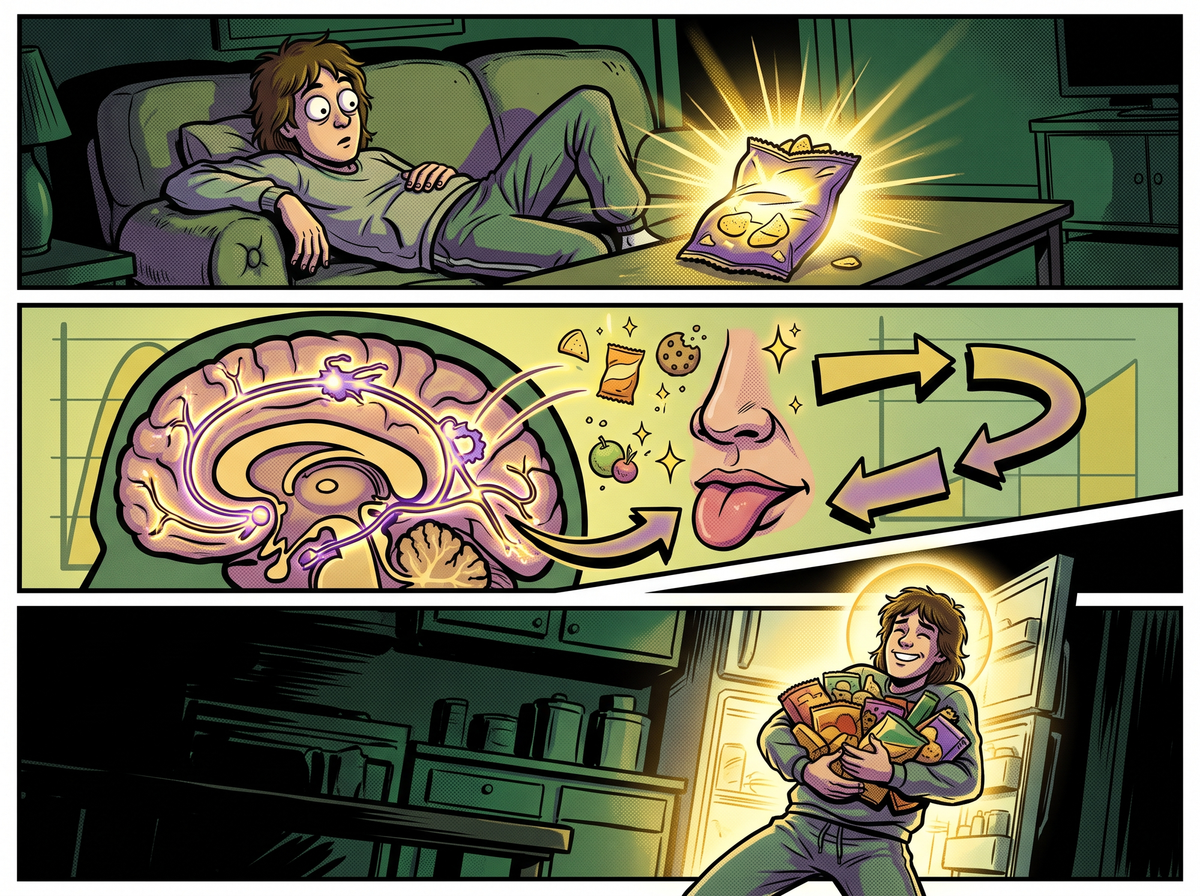
The munchies are the most reliable thing cannabis does. Forget the philosophy and the couch-lock debates; reach for a bag of something salty at an unreasonable hour and you have replicated the experiment thousands of times. This month a team at Washington State University and the University of Calgary finally caught the effect in the act, in actual people, and the explanation is stranger and more useful than the punchline suggests. It turns out the snack was never really the point. Your brain was.
Science, culture and capital — one dose at a time.
Quick Hits
The anti-munchie. A double-blind study found that THCV, a compound concentrated in some African landrace sativas like Durban Poison, boosts energy and motivation without flipping on the hunger switch. It blocks the very receptor THC tickles. "Skinny weed" is already a marketing phrase; expect to hear it more.
Psilocybin and the "suicide headache." People with cluster headaches, among the worst pain in medicine, keep rating psilocybin the most effective thing they have tried, and a small randomized trial saw attack frequency fall in its blinded extension phase. The research is finally catching up to an underground that worked this out years ago.
Beyond the two famous receptors. Researchers are mapping the "endocannabinoidome," a wider family of appetite-and-metabolism molecules like OEA and PEA that act outside the classic THC receptors, pointing toward future drugs that turn hunger up or down without any high at all.
That's the news. The analysis is below — Science Desk, Market Watch, and a closing thought.
Science Desk
The new paper, published in the Proceedings of the National Academy of Sciences, has a title only a pharmacologist could love: cannabis produces "acute hyperphagia" by increasing both the reward value of food and the motivation to go get it. In plainer terms, weed does not make your stomach growl. It makes your brain decide that the snack is the most compelling object in the known universe.
The work came out of WSU's Health and Cognition Lab, run by psychologist Carrie Cuttler, alongside veterinary neuroscientist Ryan McLaughlin, with Matthew Hill and Catherine Hume at Calgary running the animal side. (The lab's initials, gloriously, are THC.) The human arm dosed 82 volunteers between 21 and 62 with vaporized THC-dominant cannabis; parallel studies used rats. Across both, the same picture emerged, and it held regardless of someone's sex, age, weight, or how recently they had eaten.
Two findings give the effect its texture. Cannabis nudged up ghrelin, the hormone that signals hunger, and it sharpened the senses most tied to eating, smell and taste. That is the mechanism behind the universal testimony that ordinary food becomes transcendent. The flavor really is louder.
The clincher was a clean piece of pharmacology. When the Calgary team blocked cannabinoid receptors in the brain, the munchies disappeared entirely. Block them in the gut, and the effect remained. So the hunger is built upstairs, in the reward circuitry, not in the belly. That distinction is the whole story: it means the munchies are less a digestive quirk than a window into how the brain assigns wanting.
Which is where the comedy turns into medicine. A switch this reliable is genuinely valuable for the people who have lost the ability to eat, through chemotherapy, HIV and AIDS, or the wasting that comes with serious illness. Map the exact circuit and you can imagine a drug that flips appetite on without the high, or, pointed the other direction, one that turns the volume down for people who would rather it stayed quiet.
Market Watch
The munchies are not just a meme; they are a business model. The cannabis edibles market sat around $14.8 billion in 2025 and is tracking toward roughly $17 billion in 2026, growing at a brisk mid-teens annual clip and forecast near $60 billion by 2035. Every gummy and infused chocolate rides the exact circuit this study just mapped.
The opposite bet is forming too. THCV products, sold on energy and appetite control rather than indulgence, are positioning cannabis for the weight-loss-obsessed wellness market, the same cultural moment that made injectable appetite suppressants household names. One receptor, two business plans pointed in opposite directions. The plant, as usual, is happy to supply both.
The Last Word
There is something disarming about science taking the goofiest, most universal cannabis experience seriously and finding real medicine tucked inside the joke. The munchies were never only about snacks. They are a small, repeatable demonstration of how a brain decides that something is worth wanting, and how a single molecule can turn that dial. Worth a little attention, the next time the bag of chips seems to glow.
No hype, no moral panic. Just attention.
— The Alkaloid
Sources
- PNAS, "Cannabis produces acute hyperphagia in humans and rodents via increased reward valuation for, and motivation to, acquire food" (2026)
- WSU Insider and University of Calgary press releases (Feb 19, 2026)
- Marijuana Moment — THCV double-blind study on energy and appetite
- Research on the endocannabinoidome (OEA, PEA) and appetite regulation
- Psilocybin in cluster headache: randomized trial extension (Journal of the Neurological Sciences) and patient surveys (Neurology)
- Cannabis edibles market estimates, 2026 (Global Market Insights; Market.us)
The Alkaloid publishes every Tuesday. Forward this to someone who needs the dose. Subscribe for full access: TheAlkaloid.com