The Alkaloid #16: The Grandparent Trip
Psychedelic science spent sixty years studying the young. A new UC Berkeley study finally hands the eye mask to people between 60 and 85 — and asks whether an old brain can still change its mind.
The Dose
For most of the modern psychedelic era, the people most likely to have a story about a mushroom were the least likely to be invited into a study of one. The trials skewed young. A 2024 review found that adults over 60 made up only about 1.4% of participants across modern psychedelic research. Which is a strange way to test a drug whose headline promise, rebuilding worn connections between brain cells, is aimed squarely at the people who have done the most living.
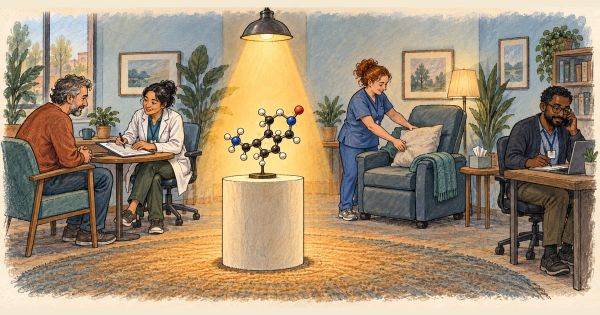
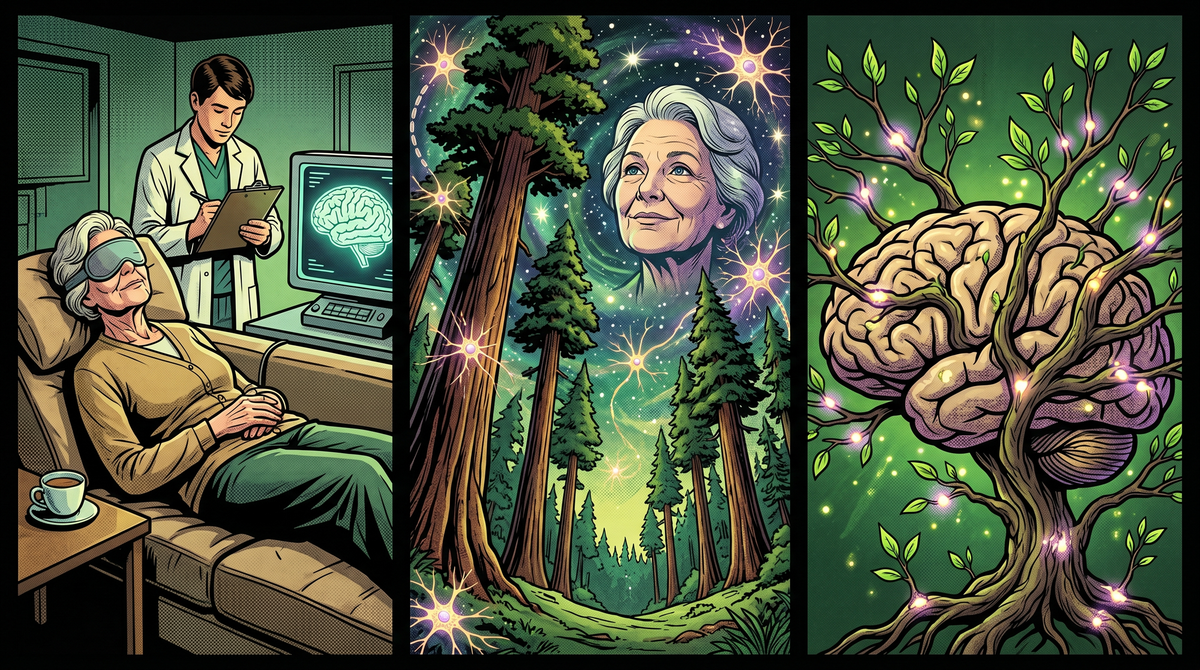
This year a lab at UC Berkeley decided to fix that. The result is a first-of-its-kind study that puts healthy 60-to-85-year-olds, an eye mask, and a carefully measured dose of psilocybin in the same quiet room, then watches what the brain does next. Science, culture and capital — one dose at a time.
Quick Hits
Ten million microdosers. New figures from RAND estimate that roughly 10 million U.S. adults took a sub-perceptual dose of psilocybin, LSD, or MDMA in 2025. Most said they were doing it for mental health rather than a good Saturday. One psychiatrist reviewing the data called the number "astounding" and declared psychedelics a "mainstream public health" matter. Whether the practice actually works is a separate question, and a stubborn one.
Maybe it really was the terpenes. A recent study from Israeli researchers reported that cannabis terpenes, the aromatic compounds behind a strain's pine-or-citrus personality, can switch on the same CB1 and CB2 receptors as THC, at broadly comparable potency. If it holds up, the "entourage effect" graduates from dispensary folklore to pharmacology, and everyone who has ever sniffed a jar like a sommelier gets to feel a little vindicated.
The government wants a sniff too. The NIH announced new funding to study minor cannabinoids and terpenes for pain relief. It is among the first real federal money pointed at the parts of the plant that aren't THC or CBD.
Loosening the wiring. A study published June 19 reported that a 25 mg dose of psilocybin temporarily relaxed the brain's usual rigid communication patterns in 28 first-time volunteers, letting networks that normally keep to themselves start talking. Hold that thought. It matters for the main story.
That's the news. The analysis is below — Science Desk, Market Watch, and a closing thought.
Science Desk
The Berkeley study carries a name only a grant committee could love: PLASTICITY, for Psychedelic Longitudinal Aging Study In Cognitively Healthy Older Adults. It runs out of the UC Berkeley Center for the Science of Psychedelics, launched earlier this year, and it is the first psychedelic neuroimaging study built specifically around older adults. The participants are between 60 and 85 and aging normally. Nobody here has a diagnosis to fix. That is the point.
The reasoning starts with rodents. In animal studies, psilocybin increases the number of synaptic connections in the hippocampus and prefrontal cortex, the memory-and-judgment neighborhoods that quietly lose connections as we age. If the same thing happens in an older human brain, a single experience might do something no supplement has managed: nudge an aging brain back toward plasticity, the capacity to rewire and adapt that we tend to spend down over a lifetime.
So the team is looking, carefully. Participants take a dose of synthetic psilocybin ranging from 1 to 30 mg. Researchers run a full assessment beforehand, then repeat it one week and one month later. The imaging is the serious part: diffusion MRI to measure the microstructure of the hippocampus, and functional MRI to watch the brain while it stores and retrieves a memory. There are vision tests, emotion and cognition batteries, and surveys that try to connect what the experience felt like to whatever shows up later in well-being.
Then there is the detail that gives the study its soul. The researchers are tracking activity in the vagus nerve during moments of awe, on the theory that awe, the feeling a redwood or a grandchild can produce with no chemistry at all, may be part of how the experience does its work. The project pulls in an unusually broad bench: doctoral student Tyler Toueg, who co-designed it; faculty director Michael Silver; Alzheimer's and brain-aging researcher William Jagust; the psychologist Dacher Keltner, who has spent a career studying awe; and psychiatrist Brian Anderson as medical director.
One honest note before anyone calls their grandmother. This is a study that has begun, not one that has finished. There are no results yet. PLASTICITY is built to find out whether the hopeful animal findings translate to people who have been alive for seven or eight decades, and that answer will take time. What is genuinely new is the question being asked at all, and the fact that the most interesting thing happening at a research lab this year involves a population that modern psychedelic science had almost entirely left out.
Market Watch
Capital, as ever, has already made up its mind. Estimates put the psychedelic-medicine market somewhere between $4.6 and $6.7 billion in 2026, depending on who is counting and what they count, with forecasts of around $26 billion by 2035 at a growth rate near 19% a year. Compass Pathways, the furthest-along name in the field, reported in October 2025 that a single dose of its synthetic psilocybin beat placebo on depression in a Phase 3 trial. It raised roughly $350 million after that readout and says it could be "launch-ready" by the end of 2026, pending an FDA decision expected to land in 2027.
Now set that against a much larger number. The "longevity economy," the catch-all for everything bought by people over 50, gets pegged near $27 trillion, and the anti-aging market alone sits around $84 billion in 2026. A therapy that can credibly say the word "brain" to a 70-year-old is standing exactly where those two booms meet. Which makes the Berkeley study something like the most valuable open question in the building: does the aging brain actually take the hint? The money is wagering yes before the data arrives. The money usually does.
The Last Word
There is something fitting about aiming the most disorienting compound we study at the people we tend to assume are done being surprised. We treat awe as a young person's nutrient, something you grow out of along with skinned knees and all-night conversations. The Berkeley team is quietly betting the opposite: that a brain at 75 might still be able to change its mind, and that being moved, by a piece of music or a grandchild or a wall of redwoods, is not a luxury but a form of maintenance.
If psilocybin earns a place in healthy aging, it won't be because it made anyone young again. It will be because it reminded an old brain that it could still bend without breaking. We don't know yet whether it can. That is precisely why it is worth watching. No hype, no moral panic. Just attention.
— The Alkaloid
Sources
- UC Berkeley News, "Tripping into old age: Can psychedelics protect the aging brain?" (June 8, 2026)
- UC Berkeley Center for the Science of Psychedelics — the PLASTICITY study
- RAND, 2025 survey on U.S. psychedelic use and microdosing
- NIH / NCCIH announcement on minor cannabinoids and terpenes for pain
- Cannabis Science & Technology — Israeli study on terpenes and cannabinoid receptors
- Psychedelic-medicine market reports (2026); Compass Pathways Phase 3 results, October 2025
- Longevity-economy and anti-aging market estimates, 2026
The Alkaloid publishes every Tuesday. Forward this to someone who needs the dose. Subscribe for full access: TheAlkaloid.com