The Alkaloid #6: The Oldest Trip in the Andes
In a high mountain valley at 10,000 feet, archaeologists found 23 snuff tubes carrying residue of vilca, a DMT-bearing plant, used 2,800 years ago in hidden chambers at Chavín de Huántar. The findings complicate every popular framing of psychedelics as inherently liberatory.

THE ALKALOID
Science, culture and capital — one dose at a time.
Issue #6 — May 1, 2026
THE DOSE
The Oldest Trip in the Andes
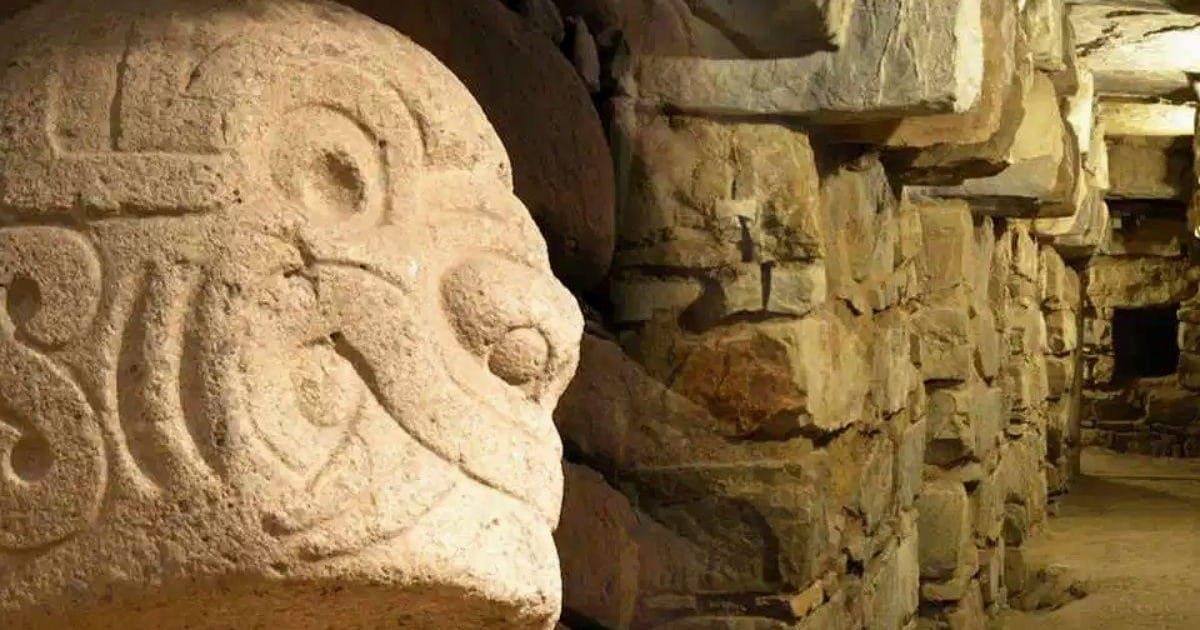
In a high mountain valley in the Peruvian Andes, at an elevation of 10,000 feet, a network of hidden stone chambers has been quietly preserving evidence of one of the most consequential rituals in human history. For nearly thirty years, an international team of archaeologists has been excavating Chavín de Huántar, a UNESCO World Heritage Site that predates the Inca empire by two thousand years. In May 2025, they published findings in the Proceedings of the National Academy of Sciences that reframe how we should understand the relationship between psychedelics, power, and the formation of complex society.
What they found, hidden in the heart of monumental stone galleries built between 1200 and 400 BCE, were 23 snuff tubes carved from hollow bird bones. Through microscopic and chemical analysis, the team identified residue from two distinct psychoactive compounds. The first was nicotine from wild tobacco relatives. The second was vilca, a hallucinogenic snuff derived from the seeds of the Anadenanthera tree, which contains compounds chemically related to DMT.
This is the earliest direct material evidence of psychoactive plant use in the Peruvian Andes. The chemicals were not consumed casually or communally. They were administered in tightly controlled rituals inside hidden underground chambers that held only a handful of participants at a time. Access was restricted. The experiences were almost certainly profound, immersive, and deliberately staged for impact.
The interpretive significance of this finding is what makes it consequential. The Chavín Phenomenon, as researchers call this lesser-known precursor civilization, shaped art, architecture, and trade networks across modern-day Peru in ways that laid the foundation for every Andean civilization that followed, including the Inca. The team behind the new study argues that exclusive access to altered states of consciousness was one of the central mechanisms by which Chavín leaders established and maintained the hierarchical social order their successors inherited.
Daniel Contreras, the anthropological archaeologist from the University of Florida who co-authored the study and has spent nearly three decades at the site, put it directly. The use of these substances at Chavín "was part of a tightly controlled ritual, likely reserved for a select few, reinforcing the social hierarchy."
This complicates a narrative that has dominated much of the contemporary psychedelic renaissance. The popular framing positions psychedelics as inherently liberatory, ego-dissolving, and democratizing. The Chavín evidence suggests something more complicated. These same compounds, in different hands, with different framing, served as instruments of social stratification. They were used to convince the people building monumental architecture that the people directing them were touched by something the rest of the population could not access.
The science is the same. The compounds are the same. What changes is the social and political context in which they are deployed.
QUICK HITS
- Vilca's chemistry confirmed. Anadenanthera contains bufotenine and small quantities of DMT and 5-MeO-DMT. The Chavín residue is the first chemical confirmation of vilca use at the site, supporting iconographic interpretations that researchers had argued for decades.
- The rituals weren't only psychedelic. Archaeologists at Chavín de Huántar have also uncovered trumpets carved from conch shells and stone chambers acoustically designed to amplify and distort sound. The full ceremonial experience combined psychoactive substances with overwhelming sensory architecture engineered to produce awe.
- Builders weren't slaves. The study team argues Chavín's builders were not coerced laborers. They likely participated in monument construction because they believed in the grandeur of what they were creating, persuaded by ceremonial experiences engineered by religious authorities. Ideology, not force, did the work.
- Earlier than expected. The new evidence pushes documented psychoactive plant use in the Peruvian Andes back to roughly 2,800 years ago. Previous estimates were considerably more recent. The deep history of plant medicine in this region is older and more sophisticated than archaeology had previously confirmed.
- A predecessor to better-known cultures. The Chavín Phenomenon predated and influenced the Moche, Wari, and ultimately the Inca civilization. Understanding Chavín ritual practice changes how researchers interpret religious and political continuity across thousands of years of Andean history.
SCIENCE DESK
The chemistry of vilca
Anadenanthera, the source of vilca snuff, is a genus of South American trees whose seeds contain a distinctive cocktail of psychoactive tryptamines. The primary active compound is bufotenine, a tryptamine related to DMT and serotonin. Smaller quantities of N,N-DMT and 5-MeO-DMT are typically present, along with N-methyltryptamine and other minor alkaloids.
When ground and prepared as a snuff, vilca produces effects that overlap with but are distinct from smoked or vaporized DMT. The onset is rapid, typically within minutes. The duration is shorter than most psychedelics, often resolving within thirty to ninety minutes. The subjective experience is reported to involve intense visual phenomena, profound shifts in body perception, and powerful emotional and spiritual content. In ceremonial contexts, traditional preparations have included additional plants that may modify the effects through MAO inhibition or other mechanisms.
The chemistry matters because it places Chavín ritual practice within a broader tradition of South American DMT-containing plant medicine that includes ayahuasca, yopo, and several other indigenous preparations. These traditions did not arise independently. They emerged from shared knowledge of regional plant chemistry that traveled across cultures, geographies, and millennia.
The Chavín finding has clinical implications worth considering. The pharmacological compounds being prepared as next-generation psychedelic medicines, including the 5-MeO-DMT formulations Biomind Labs is developing, have indigenous histories stretching back thousands of years. The compounds may be new to FDA review pathways. They are not new to humanity.
MARKET WATCH
The cultural and historical significance of the Chavín finding does not produce immediate market movement, but it shapes the long-term narrative around psychedelic medicine in ways that matter for valuations. Pharmaceutical companies developing DMT-based therapeutics, including Cybin's CYB003 program for major depressive disorder and Biomind Labs' 5-MeO-DMT formulations, increasingly face questions about indigenous origin, intellectual property, and benefit-sharing arrangements with source cultures.
The Chavín evidence reinforces a developing legal and ethical framework around psychedelic biotechnology. When pharmaceutical synthesis is built on chemistry traditional cultures developed thousands of years ago, the question of attribution and equitable distribution of benefits becomes both legally and morally serious. The Nagoya Protocol, an international agreement on access to genetic resources and benefit sharing, applies in principle to many of these compounds. In practice, enforcement remains spotty.
Companies that develop transparent benefit-sharing frameworks early may find competitive advantages as the regulatory environment matures. Companies that ignore the question may find themselves facing the kind of indigenous rights litigation that has reshaped extractive industries in recent decades.
The cannabis sector continues its regulatory limbo as the November hemp THC deadline approaches without legislative resolution. Federal rescheduling remains slow-walked. Capital flows to psychedelic biotech remain healthy following the executive order, with Compass Pathways' priority voucher and AtaiBeckley's clinical pipeline drawing the largest institutional attention.
THE LAST WORD
There is something worth sitting with in the Chavín finding that the popular psychedelic discourse has not yet fully reckoned with. We have spent the past decade telling ourselves a particular story about these compounds. They dissolve ego. They equalize. They promote connection across difference. They are, in this telling, inherently progressive substances whose only enemies are governments that fail to recognize their liberatory potential.
The Chavín evidence is a quiet correction to that framing. The same compounds that contemporary researchers describe as promoting interconnection were used 2,800 years ago in tightly controlled rituals to establish and reinforce inequality. The leaders of one of the earliest complex societies in the Americas understood, evidently quite well, that exclusive access to powerful altered states of consciousness was a tool for consolidating power. Restrict the experience. Stage the ritual. Convince the population that some people see what others cannot. The hierarchy follows naturally.
This does not invalidate the contemporary therapeutic case for psychedelics. The clinical evidence for treating depression, addiction, and trauma remains strong. What it does is complicate the political framing. Psychedelics are not inherently anything. They are powerful tools whose effects depend entirely on how they are framed, who has access to them, and who controls the rituals around them.
The same FDA-approved psilocybin clinic could, in principle, become a $400 session reserved for the wealthy or a publicly funded clinical program serving the people most harmed by drug prohibition. The same compound. The same neural mechanism. Two completely different social outcomes.
The Chavín priests understood this two and a half thousand years ago. The question now is whether contemporary culture will.
— The Alkaloid
Sources
- Proceedings of the National Academy of Sciences — Pre-Hispanic ritual use of psychoactive plants at Chavín de Huántar, Peru: https://www.pnas.org/doi/10.1073/pnas.2425125122
- ScienceDaily — Ancient Andes society used hallucinogens to strengthen social order: https://www.sciencedaily.com/releases/2025/05/250505170814.htm
- EurekAlert — Ancient Andes society used hallucinogens to strengthen social order: https://www.eurekalert.org/news-releases/1082461
- CBS News — Study sheds new light on exclusive hallucinogenic drug rituals in ancient Peru: https://www.cbsnews.com/news/chavin-de-huantar-dmt-hallucinogenic-drug-rituals-peru-study/
- Heritage Daily — Ancient ritual drug use found at Chavín de Huántar: https://www.heritagedaily.com/2025/05/ancient-ritual-drug-use-found-at-chavin-de-huantar/155227
- Ancient Origins — Elites in Ancient Andean Culture Used Hallucinogens as Tools of Oppression: https://www.ancient-origins.net/news-history-archaeology-ancient-places-americas/chavin-culture-used-hallucinogens-0022092
- Popular Archaeology — Ancient Andes society used hallucinogens to strengthen social order: https://popular-archaeology.com/article/ancient-andes-society-used-hallucinogens-to-strengthen-social-order/
The Alkaloid publishes every Tuesday. Forward this to someone who needs the dose. Subscribe for full access: TheAlkaloid.com