The Alkaloid #10: The Part Everyone Throws Away
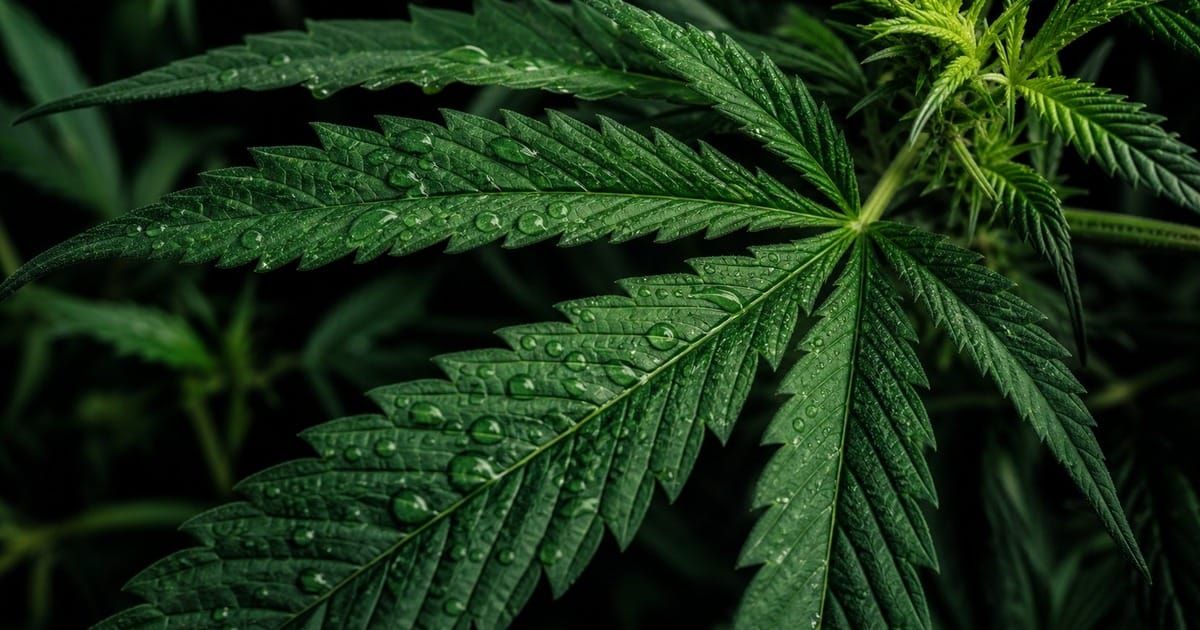
For as long as cannabis has been cultivated, the leaves have been an afterthought — biomass, waste, compost. A team of analytical chemists at Stellenbosch University just identified 79 phenolic compounds in those leaves, 25 never reported before, including 16 rare flavoalkaloids.

THE ALKALOID
Science, culture and capital — one dose at a time.
Issue #10 — May 12, 2026
THE DOSE
The Part Everyone Throws Away
For as long as cannabis has been cultivated, the leaves have been an afterthought. Farmers trim them. Processors discard them. The industry has been almost entirely focused on the flower, the resin, the cannabinoids — the compounds that get people high or treat their pain. The leaves are biomass. They are waste. They go in the compost or the trash.
A team of analytical chemists at Stellenbosch University in South Africa has published findings that should make the cannabis industry look at that waste pile very differently. Published in the Journal of Chromatography A, the study analyzed three commercially grown cannabis strains and identified 79 phenolic compounds in the leaves. Of those, 25 had never before been reported in cannabis. And hidden among them were 16 compounds that belong to a chemical group so rare that most botanists encounter them only in textbooks. Flavoalkaloids. A class of molecules so uncommon in nature that finding them in a new plant species is itself a significant discovery.
The lead researcher, Dr. Magriet Muller, an analytical chemist at Stellenbosch University's Central Analytical Facility, came to cannabis almost by accident. She had spent years developing advanced two-dimensional liquid chromatography methods and had successfully applied them to rooibos tea, grapes, and wine. She decided to apply the same tools to cannabis because she knew it was a chemically complex sample. What she found exceeded what anyone expected.
"We know that cannabis is extremely complex — it contains more than 750 metabolites — but we did not expect such high variation in phenolic profiles between only three strains, nor to detect so many compounds for the first time in the species," she said. "Especially the first evidence of flavoalkaloids in cannabis was very exciting."
The finding matters beyond the novelty. Phenolic compounds, particularly flavonoids, are already extensively studied in medicine for their antioxidant, anti-inflammatory, and anti-carcinogenic effects. The flavoalkaloids are a subclass of the same chemical family, but rarer and more poorly understood. Where flavonoids are found in thousands of plants, flavoalkaloids appear in only a handful of species. Their biological activity, when studied in those rare contexts, suggests meaningful potential in the same medical directions. The fact that they have been hiding in cannabis leaves — a part of the plant the industry routinely discards — makes the discovery particularly striking.
It also points to something larger that the research community has been slowly reckoning with. Cannabis contains more than 750 known metabolites. Most research has focused on perhaps fifty of them, almost exclusively on cannabinoids and terpenes because those are the compounds that produce effects people can feel. The hundreds of others, particularly the non-cannabinoid phenolics, have been systematically understudied simply because they don't produce an obvious high or a measurable therapeutic signal that anyone was looking for.
The Stellenbosch team's study is a reminder that the most studied drug plant in modern history is still, in some ways, almost entirely unexplored.
QUICK HITS
- 79 compounds, 25 new to cannabis. The study identified 79 phenolic compounds in cannabis leaves. Twenty-five of them had never been reported in the plant before. Sixteen were tentatively classified as flavoalkaloids — found in only one of the three strains analyzed, concentrated specifically in the leaves.
- Leaves varied dramatically between strains. One of the most surprising findings was how dramatically the phenolic profiles differed across just three strains. The flavoalkaloids appeared in only one strain's leaves. Cannabis chemical diversity at the strain level is far greater than current cultivation and testing practices account for.
- The same team cracked rooibos and wine. Muller's two-dimensional chromatography methods were developed and refined on rooibos tea, grapes, and wine before being applied to cannabis. The crossover highlights how advanced analytical tools developed for food science are opening new doors in plant medicine research.
- Cannabis pangenome completed in 2025. A separate team published the most comprehensive genetic atlas of cannabis ever assembled in May 2025, analyzing nearly 200 cannabis genomes. The genetic diversity documented there now has a new layer of chemical complexity to map against the Stellenbosch phenolic findings.
- Schedule III rescheduling is moving. The acting Attorney General formally began the process of moving cannabis from Schedule I to Schedule III this month — the biggest federal cannabis policy shift in decades. For now it applies only to medical marijuana in regulated states, but the research implications are significant. Researchers can now access high-quality licensed cannabis for federally funded studies, replacing the notoriously poor quality material previously supplied by the University of Mississippi.
SCIENCE DESK
What flavoalkaloids are and why they are rare
The plant kingdom contains somewhere between 300,000 and 400,000 known species. Flavonoids, the broader chemical family that flavoalkaloids belong to, appear in the vast majority of them. They are the compounds that give fruits their color, protect leaves from UV radiation, and attract pollinators. In medicine, they are studied extensively for antioxidant activity, anti-inflammatory effects, and anti-carcinogenic potential. If you have eaten a blueberry or drunk green tea this week, you have consumed flavonoids by the dozens.
Flavoalkaloids are a subcategory of flavonoids that contain an alkaloid component fused into their chemical structure. Alkaloids are a large class of nitrogen-containing compounds that include caffeine, morphine, quinine, and most of the classical psychedelics. When the structural features of a flavonoid and an alkaloid are combined into a single molecule, the result is a flavoalkaloid, and these molecules are almost never found in nature. They have been identified in certain species of lotus, in some orchids, and in a small number of other plants. Their biological activity, studied primarily in the handful of species that produce them, suggests potent antioxidant, anti-inflammatory, and potentially antimicrobial properties.
Finding them in cannabis leaves is surprising for several reasons. Cannabis is one of the most intensively analyzed plants in modern botanical science, having been studied by pharmaceutical researchers, agricultural scientists, forensic chemists, and regulation bodies for decades. The assumption that its chemical composition was reasonably well characterized, at least at the class level, was broadly shared. The Stellenbosch study used two-dimensional liquid chromatography combined with high-resolution mass spectrometry, techniques that are substantially more powerful than the standard single-dimension methods most cannabis analytical labs use. Without those tools, the flavoalkaloids would have remained invisible, buried beneath the far more abundant flavonoids and cannabinoids that dominate cannabis chemistry.
The larger methodological point is worth sitting with. The most studied plant in modern pharmacology still had a class of biologically active compounds that nobody had ever found in it before. The question is not how that is possible. The question is how many other plants, and how many other compound classes, are waiting for sufficiently powerful tools to become visible.
MARKET WATCH
The Stellenbosch finding has no immediate market implications for cannabis operators, but the medium-term research and product development implications are worth tracking. Cannabis leaf material is currently treated as low-value biomass. A standard trim operation discards it in volume. If flavoalkaloids and other novel phenolics in the leaves turn out to have meaningful biological activity in subsequent studies, the economic calculus around leaf extraction changes considerably.
Extraction companies that already process hemp and cannabis biomass for CBD and minor cannabinoids are the most immediately positioned to pivot. The same equipment used to extract flavonoids and terpenes can, in principle, be adapted for flavoalkaloid isolation once the target compounds are better characterized. The research timeline from initial discovery to validated extraction and commercialization is typically five to ten years, but the Stellenbosch findings give the process a clear starting point.
The Schedule III rescheduling development is more immediately significant for the market. Research access to licensed cannabis will accelerate the kind of work the Stellenbosch team is doing. Federally funded studies on cannabis phenolics, previously blocked by Schedule I classification, become substantially more viable. The pipeline of discoveries like the flavoalkaloid finding may accelerate meaningfully as American research institutions gain access to study-quality plant material.
Psychedelic biotech valuations remain healthy following the executive order, with Compass Pathways' priority voucher the closest near-term catalyst. The November hemp THC deadline approaches without legislative resolution. State-by-state cannabis markets continue to diverge, with rescheduling benefiting medical markets while recreational markets await further federal movement.
THE LAST WORD
There is a lesson tucked into this story that goes beyond cannabis chemistry. The Stellenbosch team found flavoalkaloids not because they set out to find them, but because they brought better tools to a problem everyone thought was already solved. The two-dimensional chromatography methods Dr. Muller developed were designed for rooibos tea. She applied them to cannabis because it seemed like an interesting challenge. The compounds she found had been invisible not because they were absent, but because nobody had looked at the leaves with sufficient analytical resolution.
This is how a surprising proportion of significant scientific discoveries happen. Not through ambitious targeted searches but through the application of better instruments to questions that seemed settled. The history of plant medicine is full of compounds that were always there, waiting for the right method of detection. Aspirin came from willow bark. Taxol came from yew trees. Artemisinin came from sweet wormwood. In each case, the healing compound had been present in the plant for millions of years. Human recognition was the variable.
Cannabis has been used medicinally for at least five thousand years. It has been intensively analyzed by modern chemistry for more than sixty. And last month, a team in South Africa found a class of compounds in its leaves that nobody had ever seen there before.
The plant is not finished surprising us.
— The Alkaloid
Sources
- Journal of Chromatography A — Comprehensive two-dimensional liquid chromatographic analysis of Cannabis phenolics and first evidence of flavoalkaloids in Cannabis: https://doi.org/10.1016/j.chroma.2025.466023
- ScienceDaily — Don't toss cannabis leaves: Scientists found rare compounds with medical potential: https://www.sciencedaily.com/releases/2026/05/260501002156.htm
- Stellenbosch University — Central Analytical Facility, LC-MS Laboratory: https://www.sun.ac.za/english/research-innovation/Research-Development/Documents/Postgraduate%20Research%20Support/Bursaries/SU%20Postgraduate%20Bursary%20Application.pdf
- ScienceDaily — Cannabis Pangenome Reveals Potential for Medicinal and Industrial Use: https://www.sciencedaily.com/releases/2025/05/250529124215.htm
- ScienceDaily — Don't Toss Cannabis Leaves. Scientists Just Found Rare Compounds Inside (earlier coverage): https://www.sciencedaily.com/releases/2025/09/250910000258.htm
- Bend Source — Big Moves for Plant Medicines (Schedule III context): https://www.bendsource.com/culture/columns/big-moves-for-plant-medicines/
- STAT News — 3 drug policy questions to watch in 2026: https://www.statnews.com/2025/12/24/3-drug-policy-questions-to-watch-in-2026/
The Alkaloid publishes every Tuesday. Forward this to someone who needs the dose. Subscribe for full access: TheAlkaloid.com