The Alkaloid #33: The Brain’s Own Cannabinoids
What an ageing-brain review, a mouse experiment and human blood samples can tell us about cannabinoid signalling—and what they cannot establish.

Science, culture and capital — one dose at a time
The Dose
Your brain makes its own cannabinoids. They belong to a local signalling system involved in keeping nerve cells and their surroundings working, rather than a miniature dispensary tucked behind the forehead.[1][4]
A review published October 16 in Nature Reviews Neuroscience examines how that system changes with age. It brings together research on brain maintenance and experiments in which low-dose THC altered some ageing-related outcomes in older animals. Its abstract also makes the boundary clear: clinical evidence in older humans remains limited.[1]
That leaves an interesting scientific question, without supplying an anti-ageing prescription. A biological system can deserve much more research while a product marketed in its name deserves much less confidence.
This week, we follow the evidence from mouse brain imaging to human blood samples. Neither a brighter microscope image nor a changed blood measurement can, by itself, tell an older person that cannabis will protect their memory.
Quick Hits
- The new review is a synthesis, not a new clinical trial. We inspected its publisher abstract and traced the detailed findings below to original research.[1][3][4]
- A human study published in January measured circulating signalling molecules in 142 adults who already used cannabis. It did not establish an improvement in memory or a slowing of ageing.[4]
- Our companion Field Note, When the Trial Ends, looks at four former psychedelic-trial participants’ accounts of support after research ends. Their recommendations come from a small qualitative study, with substantial company involvement disclosed in the paper.[5]
Science Desk
A signalling system, not a single dial
The endocannabinoid system includes body-made molecules such as anandamide and 2-AG, receptors they interact with, and enzymes that make or break down the molecules. THC comes from outside that system and can act on cannabinoid receptors. Sharing a receptor does not make plant THC and the body’s own signalling interchangeable.[4]
The review describes a lifespan pattern in which endocannabinoid activity is relatively high in early adulthood and declines with ageing. It also connects this signalling to processes such as inflammation control and the capacity of nerve-cell connections to change. Those are reasons to investigate the system, not evidence that everyone develops a simple cannabinoid shortage that cannabis can correct.[1]
What the mouse experiment measured
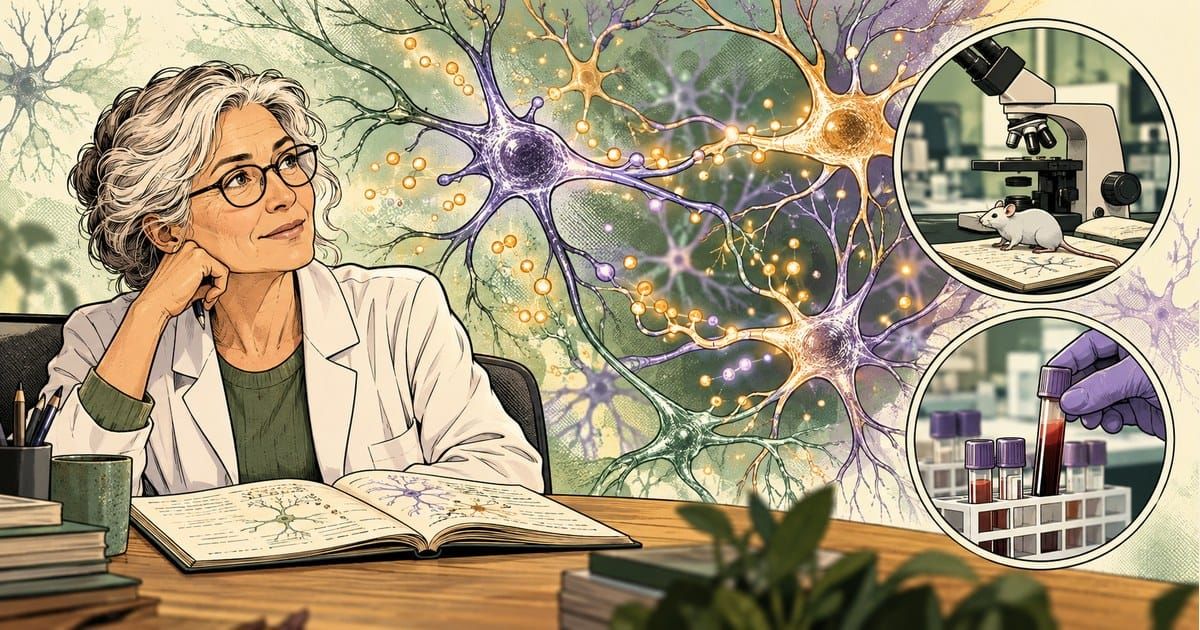
A 2023 Scientific Reports experiment repeatedly imaged tiny protrusions on nerve cells, called dendritic spines, in male mice.[3] The researchers studied eight young mice and 18 older mice, divided between THC and control groups. THC was delivered continuously through implanted pumps for 28 days.[3]
In the older mice, treatment increased spine stability and produced a sustained increase in spine density. In young mice, it transiently increased spine turnover and destabilized the spines. The same intervention behaved differently at different ages.[3]
This was a small animal experiment involving particular neurons in the somatosensory cortex. It measured structural changes, not an improvement in an older person’s memory. The implanted-pump exposure also differs from buying and using cannabis. The experiment offers a mechanism to study; it does not establish a retail regimen.[3]
Andreas Zimmer, who wrote the new review, was also an author of that mouse study. The review and experiment therefore should not be counted as independent confirmations from unrelated teams.[1][3]
What the human blood samples add
The human study examined 142 adults aged 21 to 71, including 31 people in its oldest group, aged 55 to 71. All were existing cannabis users.[4] Researchers compared laboratory baseline blood samples with samples collected on the fifth day of a product-use period, approximately an hour after cannabis flower or two hours after an edible.[4]
Anandamide and five related lipid molecules increased after use across the age groups. The other principal endocannabinoid, 2-AG, did not increase. Older participants had lower baseline levels of some, but not all, measured molecules.[4]
The exceptions matter. This was not a uniform refill of the endocannabinoid system, and circulating levels are not direct measurements of signalling inside the brain. The analysis did not test whether these changes improved cognition or prevented disease.[4]
There were practical limits, too. Participants used dispensary products in self-selected amounts, and the researchers had not biochemically verified abstinence before the baseline sample. The age comparisons were cross-sectional rather than observations of the same people growing older. The authors call for controlled studies with appropriate comparators and longer follow-up to establish clinical significance.[4]
For now, the human result tells us that cannabis use was followed by changes in certain blood molecules in this sample. The next step is to find out what those changes mean, rather than assume they are beneficial.
Market Watch
A mechanism is not a product claim
Our editorial test for an ageing-related cannabinoid claim is simple: did the research measure a change that matters to people, in the people the product is being sold to?
Neither the mouse imaging experiment nor the human blood analysis establishes that a retail cannabis product preserves memory or slows ageing.[3][4] A company invoking this biology should have to explain the gap between its product and the intervention actually studied, rather than borrow the authority of a receptor diagram.
That standard should apply equally to a familiar plant and a newly patented formulation. It protects people’s ability to make informed choices without treating cannabis use as a moral failure or demanding that promising biology be ignored.
Good research needs room to ask whether particular interventions help particular people. Consumers should not have to finance that uncertainty by buying a promise first.
The Last Word
The body’s cannabinoid signalling is more interesting than a blanket claim that cannabis is good or bad for an ageing brain. The studies point to age-dependent effects, different responses among molecules, and a substantial gap between biological measurements and demonstrated human benefit.[1][3][4]
We can be curious about that gap without filling it with advertising. Older people deserve research designed around outcomes they can actually feel and use, as well as honest accounts of uncertainty. They do not need another way to be told they are ageing incorrectly.
— The Alkaloid
Sources
Research notes: the new review was consulted at publisher-abstract level. The detailed mouse and human examples were checked in their full original papers. The mouse study reports Germany’s Excellence Strategy funding and declares no competing interests; the human study also declares no competing interests.[1][3][4]
- The endocannabinoid system and the ageing brain [1]
- Chronic low-dose Δ9-tetrahydrocannabinol (THC) treatment stabilizes dendritic spines in 18-month-old mice [3]
- Age differences in endocannabinoid tone are ameliorated after recent cannabis use [4]
- Participant experiences and recommendations for psychedelic clinical trials and future treatment delivery: a qualitative study with experts by experience from the Psychedelic Participant Advocacy Network [5]
The Alkaloid publishes every Tuesday. Forward this to someone who needs the dose. Subscribe for full access: TheAlkaloid.com