The Alkaloid #24: The Same Three Grams
Two clinical trials of lion's mane both gave subjects three grams a day. One of them used ten times more mushroom than the other. Seventeen years of research, seven small trials, and still no agreement on what a dose is. Plus Curaleaf goes hostile on Aurora, and Yale prices federal legalization.

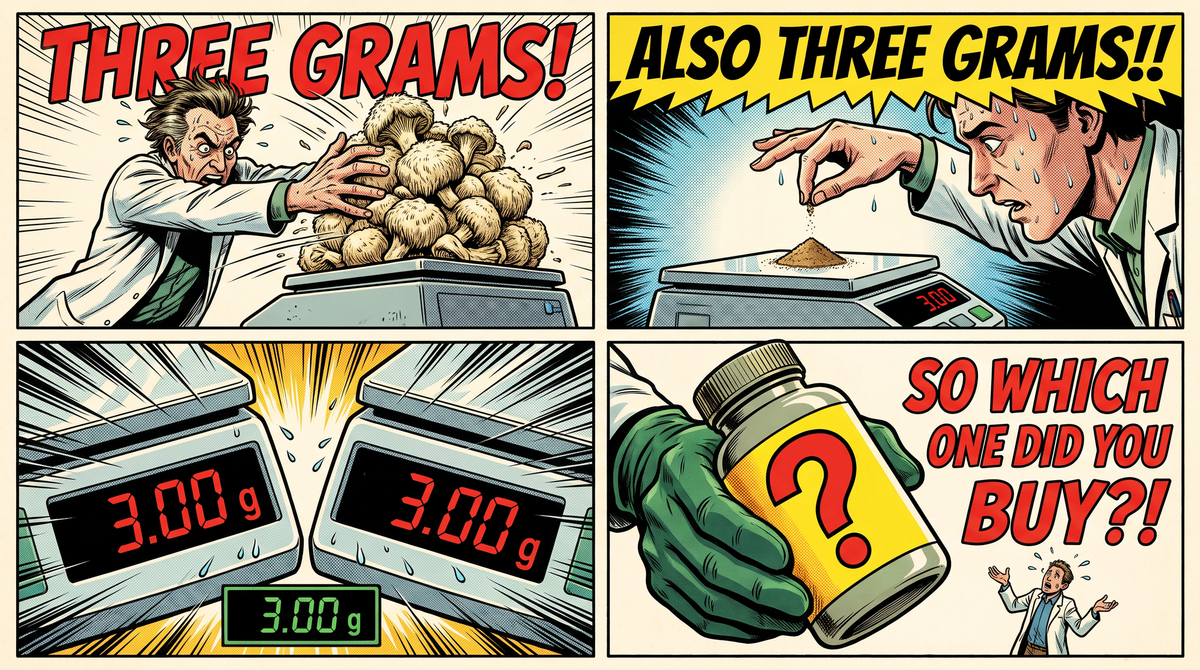
The Dose
Two clinical trials of lion's mane mushroom gave their subjects three grams a day.
One of them used ten times more mushroom than the other.
In 2009, a team led by Koichiro Mori gave thirty Japanese adults with mild cognitive impairment four 250mg tablets, three times daily. The tablets were 96% dried Hericium erinaceus powder. Three grams of mushroom, more or less literally.
In 2025, researchers at the University of Surrey gave eighteen healthy young adults three grams of a 10:1 fruiting body extract stirred into lemon squash. A 10:1 extract means ten kilograms of mushroom went in and one kilogram came out. Their three grams carried the material of roughly thirty grams of the 2009 study's mushroom.
Both papers say three grams. Neither is wrong. They are simply not measuring the same thing, and no reader of a headline would ever know.
This is the problem with lion's mane, and it is not the one people usually argue about. Forget for a moment whether the mushroom works. Ask instead whether anyone has run the same experiment twice.
Quick Hits
Curaleaf goes hostile on Aurora. Curaleaf Holdings formally launched an unsolicited takeover bid for Aurora Cannabis on August 18, after signaling its intent on the 11th. The offer is 0.3463 Curaleaf shares plus US$0.75 cash per Aurora share, an implied US$4.00, a 45% premium to Aurora's 30-day volume-weighted average of US$2.75. No financing conditions, no due diligence conditions. It expires December 1.
A Phase 3 LSD trial hit its endpoints. Definium Therapeutics reported topline results on August 12 from its Voyage study of DT120, an orally disintegrating lysergide tablet, in generalized anxiety disorder. A single 100 microgram dose cut Hamilton Anxiety scores by 11.6 points at week 12 against 6.2 for placebo, a placebo-adjusted difference of 5.4 points across 214 randomized participants at about 35 US sites. Response rate 43% versus 16%. A confirmatory trial reads out next month.
Yale put a number on federal legalization. The Budget Lab at Yale published an analysis on August 17 estimating that federal marijuana legalization would raise $57.9 billion in tax revenue over ten years, or $111.3 billion if every state legalized too. The model assumes a potency-based excise tax of $0.00625 per milligram of THC, which works out to $1.31 per gram against an average price of $8.59. The authors flag "an unusual degree of uncertainty" in their own estimate, which is more candor than most revenue projections offer.
North Carolina keeps the odor rule. In State v. Schiene, decided August 14, the North Carolina Supreme Court held unanimously that the smell of cannabis can count as one factor among many supporting a warrantless vehicle search. The defense had argued that legal hemp makes the odor useless as evidence, since the two plants smell identical. The court disagreed. It is the third such ruling from that bench this year.
Legalization added farm jobs, not farm wages. Researchers from Texas Tech presented findings at the Agricultural and Applied Economics Association meeting this month showing that states enacting legalization saw agricultural employment rise about 9% against a synthetic control, drawing on Bureau of Labor Statistics data from 1990 to 2024. Wages did not move, which the authors attribute to an elastic farm labor supply. It is a conference paper and has not been peer reviewed.
Georgia proposes mailing medical cannabis. The Georgia Access to Medical Cannabis Commission has floated rules that would let licensed dispensaries ship product by USPS, FedEx or UPS, citing this year's federal move of state-licensed medical cannabis to Schedule III. Delivery would require tracking and a signature from the patient or caregiver. Public comment is set for September 16.
That's the news. The analysis is below — Science Desk, Market Watch, and a closing thought.
Science Desk
Lion's mane makes two families of compounds that interest neuroscientists, and they do not come from the same place.
Hericenones are found in the fruiting body, the white shaggy thing that looks like a small sea creature and turns up on restaurant menus as a scallop substitute. Erinacines are found in the mycelium, the thread network the fruiting body grows out of. Both stimulate nerve growth factor in laboratory conditions. They are structurally different molecules produced at different stages of the organism's life.
So a bottle that says "lion's mane" has told you the species and nothing about the chemistry.
Line up the human trials and the incoherence is immediate.
Mori 2009, Phytotherapy Research: thirty adults aged 50 to 80 with mild cognitive impairment, 3g/day of dried fruiting body powder, sixteen weeks. Scores on the Revised Hasegawa Dementia Scale improved at weeks 8, 12 and 16. Four weeks after the tablets stopped, the scores fell back down.
Li and colleagues 2020, Frontiers in Aging Neuroscience, out of Chung Shan Medical University in Taiwan: forty-one completers with early Alzheimer's, 1,050mg/day of mycelium enriched to 5mg of erinacine A per gram, forty-nine weeks. Mini-Mental State Examination scores improved, as did contrast sensitivity.
Surendran and colleagues 2025, Frontiers in Nutrition, University of Surrey: eighteen healthy adults aged 18 to 35, a single 3g dose of 10:1 fruiting body extract, tested ninety minutes later. Global cognition, no effect. Mood, no effect. Subjects did slightly worse on the Flanker task and Trail Making B. The only improvement was on a grooved pegboard, which measures how fast your hands work rather than how fast you think.
Daoust and colleagues, posted to medRxiv on April 17 of this year and not yet peer reviewed: 109 adults aged 40 to 75 who reported feeling mentally foggy, 2g/day for eight weeks. Significantly better visual attention and working memory than placebo, plus improved sleep quality, morning restedness and mood.
Four studies. Four different materials, four doses spanning almost threefold before you adjust for concentration, durations running from ninety minutes to forty-nine weeks, and populations from healthy twenty-somethings to patients with diagnosed Alzheimer's. The Surrey trial that found nothing gave the largest amount of raw material of any of them, in a single dose, to people whose cognition had nothing wrong with it. That is not a failed replication. It is a different experiment wearing the same word.
Two of the four disclose commercial funding. Surrey's paper lists two authors employed by Beyond Alcohol Ltd., which sells lion's mane products and covered the publication fees. The 2026 preprint was funded by M2 Ingredients, a mushroom ingredient manufacturer and the parent company of the retail brand Om Mushroom Superfood; the authors note the sponsor could review the analyses but not alter them. Both disclosures are proper and neither invalidates anything. It is still worth knowing that the trial finding nothing and the trial finding something were each paid for by someone in the business.
The Alzheimer's Drug Discovery Foundation, which has no product to sell, counts seven randomized controlled trials in its Cognitive Vitality review, last updated September 2025. Its verdict is that they are small, short and inconsistent, that "dosage has not been established," and that there is "a lack of standardization in extraction methods and levels of bioactive compounds."
A systematic review published in Frontiers in Pharmacology in June 2025 by Spangenberg, Moneypenny, Bozzo and Perreault went further. They gathered twenty-three studies of erinacines and neuroprotection. Not one was a human trial. Their explanation for why the field has stalled is worth quoting: the missing reporting of erinacine concentration, "given the variability of strain, cultivation, extraction and dosing," they write, "greatly reduces the translatability and reproducibility of studies."
The labels do not close the gap either. The figure most quality-focused brands print is beta-glucan content, often guaranteed above 30%. That number is genuinely useful, because beta-glucans are fungal and starch is not, so a high figure is decent evidence you bought mushroom rather than the grain it was grown on. But beta-glucans are neither hericenones nor erinacines. The one number the honest labels give you is not the number the cognition research is about.
You can buy a well-made, honestly labeled, independently tested lion's mane product and still have no way to match it to any trial ever run.
Market Watch
The money has not waited for the science, and it does not agree with itself either.
Future Market Insights valued lion's mane and functional mushroom extracts at USD 1.5 billion in 2026 in a report published August 3, forecasting USD 5.6 billion by 2036 at a 14% compound annual rate. Lion's mane is 37.7% of the species mix. Cognition is 47.9% of stated applications. And erinacines account for 62.6% of the actives, meaning the market has quietly bet on the mycelium compounds while much of the premium retail shelf sells itself on fruiting body purity.
Then again, Grand View Research puts lion's mane extract alone at USD 2.01 billion in 2025, larger than Future Market Insights' entire category the following year. DataM Intelligence sizes all mushroom extracts at USD 7.46 billion. Technavio's growth rate is 23.4%, nearly double FMI's. These cannot all be true. Nobody agrees on the dose, and it turns out nobody agrees on the market either.
Retail pricing produces the strangest finding of the week. Concentrated fruiting body extracts run roughly $0.48 to $0.58 per serving: Nootropics Depot sells 500mg of an 8:1 dual extract for about half a dollar a dose, Real Mushrooms about $0.58 for a full gram. Mycelium-on-grain products cost more. Om Mushrooms' capsules, which disclose mycelial biomass cultured on organic whole oats, run about $0.93 per two-gram serving. Host Defense, disclosing fermented brown rice biomass, runs $0.79 to $1.05 per gram depending on the retailer. Buying the grain substrate costs between 60% and 110% more per serving than buying the concentrate.
In February, Real Mushrooms acquired Mushroom Science, founded in 1994 and generally credited as the first US brand to press the fruiting-body-versus-grain distinction publicly. The two loudest critics of grain filler are now one company. Whether that makes the argument louder or just narrower is an open question.
The beverage side keeps expanding regardless. Ryze launched into 1,978 Target stores in January at a $9.99 price point. Everyday Dose reached about 1,500 Targets in December. Reformed, a functional coffee brand built on lion's mane and chaga, raised a $22 million Series A in July on roughly $70 million of annualized revenue twenty months after launch. Mushroom coffee itself is growing at about 5.5% a year by both Precedence Research and Grand View's reckoning, considerably slower than the extract ingredients going into it.
The Last Word
It would be easy to file this under debunking, and that would miss it.
Lion's mane is a real organism with real chemistry. Hericenones and erinacines do stimulate nerve growth factor in a dish. Erinacine A turns up in the brain tissue of rats given a large oral dose, and a 2024 pilot study found it in the cerebrospinal fluid of a single landrace pig, which is the sort of sentence you only get to write about a field this young. Four human trials, whatever their flaws, have found something more often than they have found nothing. The mushroom is also delicious, which counts for something and gets mentioned less than it should.
Nobody here is lying. The category simply never agreed on a unit, and seventeen years of research has been quietly paying for that.
Drug development solved this a long time ago, and not because pharmaceutical companies are more honest. Regulators made it a condition of entry. You cannot run a Phase 3 without naming the molecule, the milligrams and the manufacturing process, because otherwise nobody can check your work. Supplements carry no such obligation. So seven small trials have each tested a slightly different substance and reported the result in a unit nobody defined.
That is what leaving something in the food aisle actually costs. The oversell is the obvious part and the smaller one. The larger cost is that a decent question becomes unanswerable while everyone argues over the answer.
The fix needs no new law and no new science. Report erinacine and hericenone content in milligrams, state the extraction ratio and the substrate, and run the same preparation twice. It is bookkeeping.
Until somebody does, every study will be a first study, and three grams will go on meaning whatever the person printing the label wants it to mean.
— The Alkaloid
Sources
- Mori K, Inatomi S, Ouchi K, Azumi Y, Tuchida T. "Improving effects of the mushroom Yamabushitake (Hericium erinaceus) on mild cognitive impairment: a double-blind placebo-controlled clinical trial." Phytotherapy Research 23(3):367-372, 2009. https://onlinelibrary.wiley.com/doi/10.1002/ptr.2634
- Li et al. "Prevention of Early Alzheimer's Disease by Erinacine A-Enriched Hericium erinaceus Mycelia Pilot Double-Blind Placebo-Controlled Study." Frontiers in Aging Neuroscience, 2020. https://www.frontiersin.org/journals/aging-neuroscience/articles/10.3389/fnagi.2020.00155/full
- Surendran G, et al. "Acute effects of a standardised extract of Hericium erinaceus (Lion's Mane mushroom) on cognition and mood in healthy younger adults: a double-blind randomised placebo-controlled study." Frontiers in Nutrition, February 28, 2025. https://www.frontiersin.org/journals/nutrition/articles/10.3389/fnut.2025.1405796/full
- Daoust J, Farrar S, Grant AD, et al. "A randomized, double-blind, placebo-controlled study evaluating the impact of Hericium erinaceus on cognitive performance and subjective wellbeing." medRxiv preprint, April 17, 2026. https://www.medrxiv.org/content/10.64898/2026.04.13.26350781v1
- Spangenberg ET, Moneypenny A, Bozzo GG, Perreault ML. "Unveiling the role of erinacines in the neuroprotective effects of Hericium erinaceus: a systematic review in preclinical models." Frontiers in Pharmacology, June 23, 2025. https://www.frontiersin.org/journals/pharmacology/articles/10.3389/fphar.2025.1582081/full
- "A pilot pharmacokinetic and metabolite identification study of Erinacine A in a single landrace pig model." Heliyon, 2024. https://pmc.ncbi.nlm.nih.gov/articles/PMC11417322/
- Alzheimer's Drug Discovery Foundation, Cognitive Vitality: Lion's Mane. Updated September 3, 2025. https://www.alzdiscovery.org/cognitive-vitality/ratings/lions-mane
- Future Market Insights, "Lion's Mane and Functional Mushroom Extracts Market," August 3, 2026. https://www.futuremarketinsights.com/reports/lions-mane-and-functional-mushroom-extracts-market
- Grand View Research, Lion's Mane Extract market statistics. https://www.grandviewresearch.com/horizon/statistics/mushroom-extracts-market/product/lion-s-mane-extract/global
- Precedence Research, "Mushroom Coffee Market," January 21, 2026. https://www.precedenceresearch.com/mushroom-coffee-market
- Real Mushrooms, "Real Mushrooms Acquires Mushroom Science," February 26, 2026. https://www.globenewswire.com/news-release/2026/02/26/3245505/0/en/Real-Mushrooms-Acquires-Mushroom-Science-Uniting-to-Advance-Integrity-and-Transparency-in-Functional-Mushroom-Supplements.html
- Curaleaf Holdings, "Curaleaf Announces Intention to Launch Take-Over Bid for Aurora Cannabis," August 11, 2026. https://ir.curaleaf.com/2026-08-11-Curaleaf-Announces-Intention-to-Launch-Take-Over-Bid-for-Aurora-Cannabis-to-Solidify-its-Position-as-the-Global-Cannabis-Industry-Leader
- Definium Therapeutics, "Positive Topline Results from Phase 3 Voyage Study of DT120 ODT in Generalized Anxiety Disorder," August 12, 2026. https://www.businesswire.com/news/home/20260812579720/en/Definium-Therapeutics-Announces-Positive-Topline-Results-from-Phase-3-Voyage-Study-of-DT120-ODT-in-Generalized-Anxiety-Disorder
- The Budget Lab at Yale, "Federal Tax Implications of Legalizing Marijuana," August 17, 2026. https://budgetlab.yale.edu/research/federal-tax-implications-legalizing-marijuana
- State v. Schiene, North Carolina Supreme Court, August 14, 2026. https://appellate.nccourts.org/opinions/?c=1&pdf=46064
- Agricultural & Applied Economics Association 2026 annual meeting paper on legalization and agricultural employment. https://ageconsearch.umn.edu/record/404370
- Georgia Access to Medical Cannabis Commission, notices of intent to amend Rule Chapter 351. https://mailchi.mp/gmcc.ga.gov/notices-of-intent-to-amend-and-adopt-rules-in-rule-chapter-351
The Alkaloid publishes every Tuesday. Forward this to someone who needs the dose. Subscribe for full access: TheAlkaloid.com