The Alkaloid #15: The Factory in the Leaf
A lab in Israel engineered one tobacco plant to make psilocybin, DMT, bufotenin, 5-MeO-DMT, and psilocin at once. The molecules just left the mushroom and the toad behind. What that means for cost, supply, and a drug law written when the drug and its source were the same thing.

The Dose
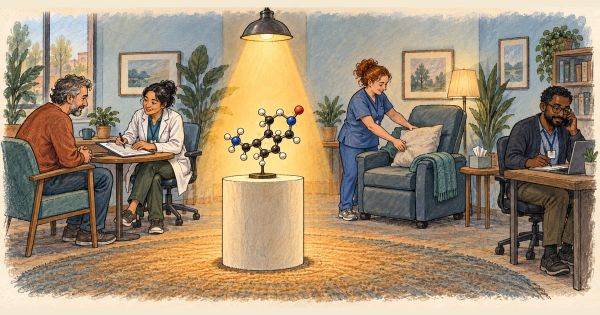
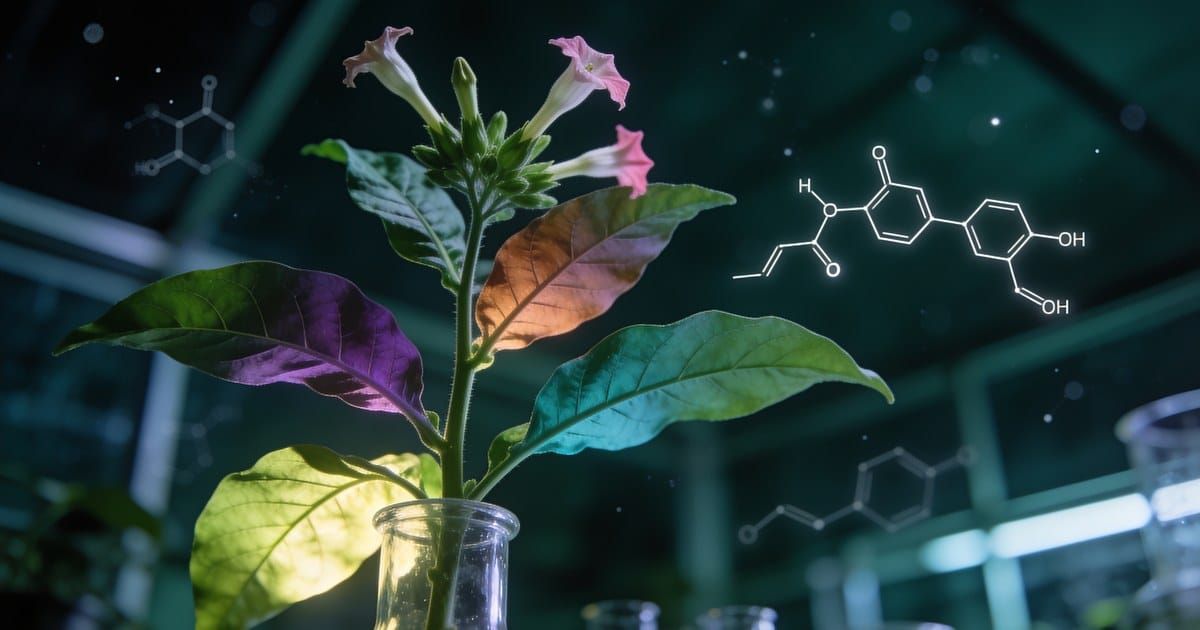
A tobacco plant in an Israeli lab recently made psilocybin. It also made DMT, bufotenin, 5-MeO-DMT, and psilocin. Five psychedelic compounds that in nature come from a mushroom, a couple of shrubs, and a desert toad, all produced at once inside the leaves of a single engineered plant.
The work came out April 1 in Science Advances, from a team at the Weizmann Institute of Science. The headlines mostly stopped at “trippy tobacco.” The more interesting part is quieter. For the first time, the recipe for these molecules has been pulled out of the organisms that evolved them and dropped into a fast-growing plant that will do as it’s told.
That detail matters more than the novelty. Almost everything in drug policy, from scheduling to sourcing to who owns the supply, assumes the drug is tied to its source. Take away the mushroom and the toad, and a lot of settled questions come unsettled.
Quick Hits
- The bigger cannabis fight lands June 29. Medical and FDA-approved marijuana already moved to Schedule III in April. Whether all cannabis follows now goes to an expedited DEA hearing that runs June 29 through mid-July. Before it even opens, prohibitionist groups have asked the D.C. Circuit to stay the process. The reform that took fifty-six years to arrive may turn on a courtroom scheduling order.
- Virginia finally has a retail deal. Governor Spanberger and legislative sponsors reached a compromise to fold recreational sales into the budget, with stores opening July 2027, a two-ounce per-visit cap, and an 8 percent excise tax phased in after two years. Five years after legalizing possession, the state is closing the gap that gray markets had been happy to fill.
- The Senate is building scaffolding for psychedelic therapy. A bipartisan bill would create an Office of Novel Therapeutics inside the VA to prepare for an FDA approval that backers treat as a matter of when, not if. A companion bill would fund at least five VA centers focused on psychedelic care. The politics here keep crossing the usual lines.
- The DEA wants more psychedelics made, not less. In the same stretch it has spent slow-walking cannabis, the agency more than doubled its 2026 production quota for psilocyn and raised the ceilings for psilocybin and DMT, all to feed research. Supply, it turns out, is the part of this story everyone is suddenly racing to solve.
That’s the news. The analysis is below — Science Desk, Market Watch, and a closing thought.
Science Desk
Start with how. The team did not set out to make five drugs. They set out to answer one question: how does a plant turn the amino acid tryptophan into DMT? Tryptophan is everywhere, the raw material of proteins, and tobacco makes a lot of it. The missing piece was the set of enzymes that rewrite it into a psychedelic.
To find them, the researchers read the active genes in three plants that already make DMT, two relatives of coffee used in ayahuasca and an Australian tree. Two candidates stood out, named PvTDC1 and PvTDC2. Inserted into tobacco, they turned the plant into a DMT factory. Once that pathway was mapped, the rest followed, because psilocybin, psilocin, bufotenin, and 5-MeO-DMT are all built from the same tryptophan starting block with a few different finishing steps. Add the right enzymes and the plant makes the whole set, the toad’s molecule included, inside a week.
Now the caveats, because they are the story too. The plants were not permanently changed. The new genes were delivered by bacteria and expressed temporarily, so nothing is inherited and there are no seeds to pass around. That was deliberate. As co-author Asaph Aharoni put it, making the trait heritable gets tricky fast when the product is also a recreational drug and people start asking for seeds. The plants that made all five at once also made less of each, well below the yields of plants tuned for a single compound. One outside bioengineer, Andrew Jones of Miami University, doubts tobacco wins the scale-up race at all and expects engineered microbes to do the heavy lifting.
So this is a proof of concept, not a production line. What it proves is the part that counts: the path to these molecules is now understood well enough to rebuild in a host of our choosing. The mushroom and the toad were never the point. They were just the only factories we had.
Market Watch
Follow the cost. Pharmaceutical-grade psilocybin made to GMP standards runs somewhere between $5,000 and $10,000 a gram, because chemical synthesis is finicky and growing mushrooms gives uneven yields. That price is a tax on every trial and, eventually, every prescription.
This is why the supply race is heating up even though the molecules themselves are ancient. Precision fermentation, brewing psychedelics in engineered yeast or bacteria the way insulin is made, has pushed lab yields past two grams per liter in a bioreactor, and a handful of synthetic biology firms, Denmark’s Octarine and the yeast-based Psylink among them, are chasing cheap, consistent, pharma-grade output. The Weizmann plants are another entry in the same contest, attacking the cost from the greenhouse instead of the fermenter.
The money is watching. In late March, Japan’s Otsuka agreed to buy the drug developer Transcend Therapeutics in a deal worth up to roughly $1.2 billion, built around an MDMA-like compound headed for Phase 3 trials in PTSD. When supply gets cheap and reliable, the molecule stops being the moat. The advantage shifts to whoever owns the trials, the approvals, and the care model wrapped around the dose. That is also, worth noting, the exact spot where cannabis lost the plot, letting commodity flower race to the bottom while the value moved elsewhere.
The Last Word
There is a clean idea hiding inside the messy one. For all of human history, a psychedelic and its source were the same thing. You wanted psilocybin, you found the mushroom. You wanted 5-MeO-DMT, you met the toad. The Weizmann plant breaks that link. The molecule becomes information, a pathway that can be copied into whatever host is convenient.
Our drug laws have not caught up, because they were written for the old world. Scheduling regulates plants, fungi, and one specific desert amphibian. It has very little to say about a tryptophan pathway running inside a crop. That gap is not a reason to panic. It is a reason to think now, while this still lives in labs, about rules that hold up when the drug travels separately from the thing that used to make it.
There is a fairness question underneath, too. These compounds are not lab inventions. They come from living traditions, ayahuasca in the Amazon, mushrooms in Mesoamerica, the toad in the Sonoran Desert, knowledge held by people who were rarely asked and almost never paid. If the next phase of this medicine grows in a greenhouse in the global north, the least we can do is be honest about where the recipe came from. Cheaper supply is good for patients, and it should be. It does not have to come at the cost of forgetting.
— The Alkaloid
Sources
- “Scientists Engineered Tobacco Plants to Produce Five Mind-Altering Psychedelic Compounds,” Smithsonian Magazine (April 7, 2026)
- “Trippy tobacco plants engineered to make five psychedelics at once,” Science (April 2026)
- Weizmann Institute study, Science Advances, DOI 10.1126/sciadv.aeb3034 (April 1, 2026)
- “Scientists engineered plants to produce five psychedelics at once,” The Microdose, UC Berkeley (April 10, 2026)
- DEA 2026 aggregate production quotas, final rule, Federal Register / Marijuana Moment
- “Cannabis News Today, 15 June 2026,” Business of Cannabis
- Otsuka–Transcend acquisition, Psychedelic Alpha (March 2026)
- GMP cost and microbial titer figures, SynBioBeta and metabolic-engineering literature
The Alkaloid publishes every Tuesday. Forward this to someone who needs the dose. Subscribe for full access: TheAlkaloid.com