
The Alkaloid #12: The Tax Break and the Cell
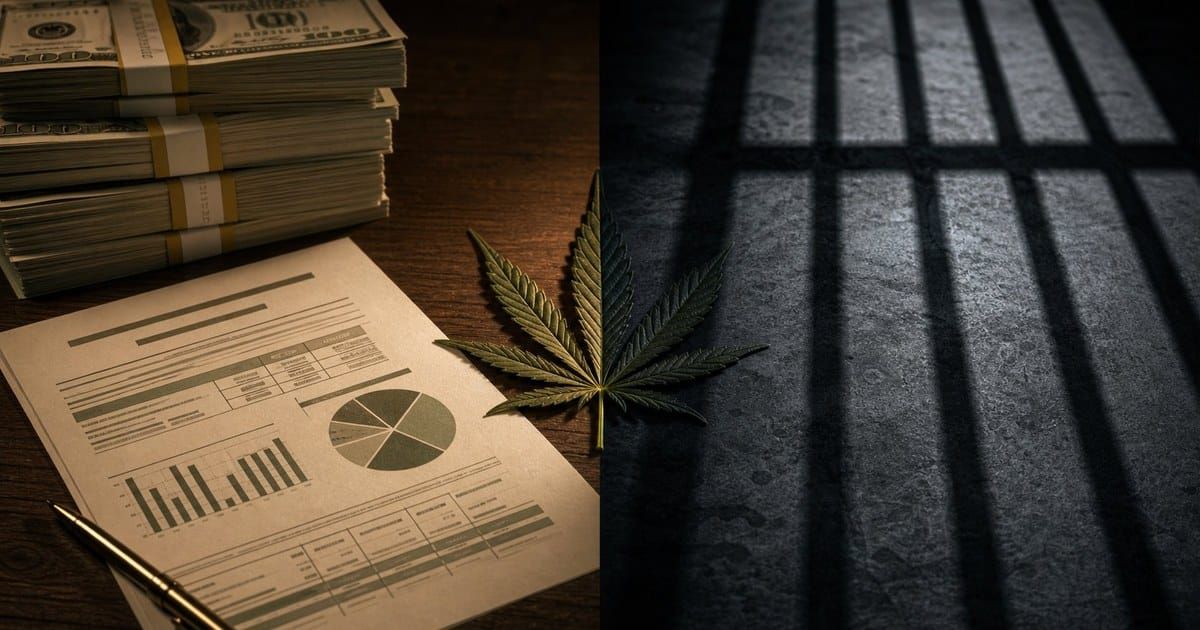
In April, the DOJ rescheduled medical cannabis to Schedule III — handing operators billions in tax relief. It opened zero prison cells. Now 29 members of Congress want Trump to commute the sentences of roughly 3,000 people still serving federal time for a drug the government just reclassified.

The Dose
Last week, 29 members of Congress sent a letter to the one person who can do something about the people prohibition left behind.
Representatives Steve Cohen of Tennessee and Steven Horsford of Nevada led it, along with Senator Cory Booker of New Jersey. The ask: that President Trump commute the sentences of everyone in federal prison for nonviolent marijuana offenses. Six senators and 23 House members signed. It was addressed to Trump and to Alice Marie Johnson, the White House "pardon czar."
The request follows directly from something we covered in Issue #11. In April, Trump's own Justice Department rescheduled medical cannabis from Schedule I to Schedule III. The government formally admitted that cannabis has accepted medical use and a lower potential for abuse than it had claimed for fifty-six years. That one administrative act handed the cannabis industry billions in tax relief.
It opened zero prison cells.
That gap is what the letter is trying to close. The same government that just reclassified the drug is still holding roughly 3,000 people in federal prison for selling it.
Quick Hits
The numbers. U.S. Sentencing Commission data cited in the letter estimates about 3,000 people remain federally incarcerated for marijuana trafficking offenses. Hundreds, possibly thousands, are serving mandatory minimums of five years or longer. Some are serving life.
The ask is specific. The lawmakers want a "categorical commutation," meaning one executive action that covers everyone serving time for nonviolent cannabis offenses rather than a slow case-by-case review. They argue the rescheduling order gives Trump both the precedent and the political cover to do it.
The clemency context is striking. Trump has been the most active clemency president in modern history during his second term, granting pardons or commutations to more than 1,600 people. Almost none have been cannabis prisoners.
This is not new ground for him. On his last day in office in January 2021, Trump commuted the sentences of about a dozen cannabis prisoners, including Corvain Cooper, who was serving life. The precedent exists. The question is whether he uses it at scale.
It is bipartisan history, if not bipartisan present. This letter is Democrat-led, but past clemency pushes for cannabis prisoners drew Republican lawmakers, a former U.S. attorney, and law enforcement groups. Cannabis clemency has unusual cross-aisle roots.
That's the news. The analysis is below — Science Desk, Market Watch, and a closing thought.
Science Desk
The strongest argument in the letter isn't a moral one. It's in the sentencing data.
Decades of U.S. Sentencing Commission figures show that cannabis sentencing has fallen along sharply racial lines. Use rates are roughly equal across racial groups, but Black and Hispanic defendants have made up a large majority of federal marijuana trafficking convictions, and have drawn longer average sentences than white defendants for comparable conduct. The pattern tracks who gets policed and charged, not who uses.
The mechanism is worth understanding. Federal mandatory minimums for drug offenses are triggered by weight thresholds and prior convictions, not by violence or harm. A nonviolent defendant with two prior drug felonies, themselves often the product of the same enforcement patterns, can face a sentence on par with one handed down for a violent crime. That is how a person like Corvain Cooper ends up with a life sentence for a cannabis conspiracy.
Rescheduling does not touch any of this. Schedule III changes how the drug is classified for medical and tax purposes going forward, and it does nothing retroactively. Sentences handed down under Schedule I remain fully in force, calculated under a framework the government has now effectively walked away from. The people serving them are imprisoned under a classification that, for these purposes, no longer exists.
Market Watch
The contrast here is what makes the issue land.
When medical cannabis moved to Schedule III in April, it pulled those operators out from under IRS Section 280E, the provision that blocked cannabis businesses from deducting ordinary expenses and pushed effective tax rates past 70 percent. Analysts put the industry-wide cash flow improvement at more than $2 billion a year, and Treasury guidance indicates the relief reaches back across the full 2026 tax year. If the DEA's June hearing extends rescheduling to recreational cannabis, the figure climbs into the high single-digit billions.
So one policy event produced two completely different outcomes for two groups defined by the same plant. Businesses got a multibillion-dollar retroactive tax benefit applied automatically, no application required. Prisoners got nothing. No retroactive relief, no automatic mechanism, no change to their sentences at all.
One group is getting money back for past years. The other is still serving time for them. Both outcomes come from the same reclassification. The difference is that capital has lobbyists and a tax code, and the people in prison have a letter from 29 members of Congress and the hope that the president reads it.
Last Word
Rescheduling was always going to be judged by what it left out. The tax relief was the easy part. It asked no one to admit the old policy had ruined lives, only that it had been bad for business. Commuting these sentences asks for the harder thing: an admission that the government imprisoned thousands of people for something it has now decided isn't what it said it was.
A categorical commutation wouldn't fix prohibition. It would close the cruelest gap prohibition opened, the one where the drug gets reclassified, the industry gets paid, and the people still inside are told to wait and see if a letter works.
— The Alkaloid
Sources
Marijuana Moment, "Democratic Lawmakers Push Trump To Release Federal Marijuana Prisoners As A Follow-Up To Rescheduling," May 2026
The Marijuana Herald, "Nearly 30 Lawmakers Push President Trump to Commute Sentences for Federal Marijuana Prisoners," May 22, 2026
Hemp Gazette, "Democratic Lawmakers Urge Commutation for Federal Cannabis Prisoners Following Rescheduling Initiative," May 2026
Vicente LLP, "Cannabis Rescheduling to Schedule III: Economic Impacts on Businesses, Jobs and Tax Reform," May 2026
Cannabis Regulations AI, "Cannabis 280E After Schedule III: The 2026 Operator and CPA Tax Playbook"
The Outlaw Report, "Clemency For 12 Cannabis Prisoners Thanks To Trump's Last-Minute Pardons"
Washington Examiner, "Trump's most controversial pardons and acts of clemency in 2025," January 2026
U.S. Sentencing Commission data on federal marijuana trafficking offenses and sentencing disparities
The Alkaloid publishes every Tuesday. Forward this to someone who needs the dose. Subscribe for full access: TheAlkaloid.com