The Alkaloid #29: The Right to Have It. Nowhere Legal to Buy It.
Massachusetts could preserve an adult's right to possess cannabis while closing recreational shops and ending home grows. Who benefits—and what would police be asked to do again?

Science, culture and capital — one dose at a time
The Dose
Massachusetts could let adults keep an ounce of cannabis while taking away the licensed shops that sell it and the right to grow it at home.
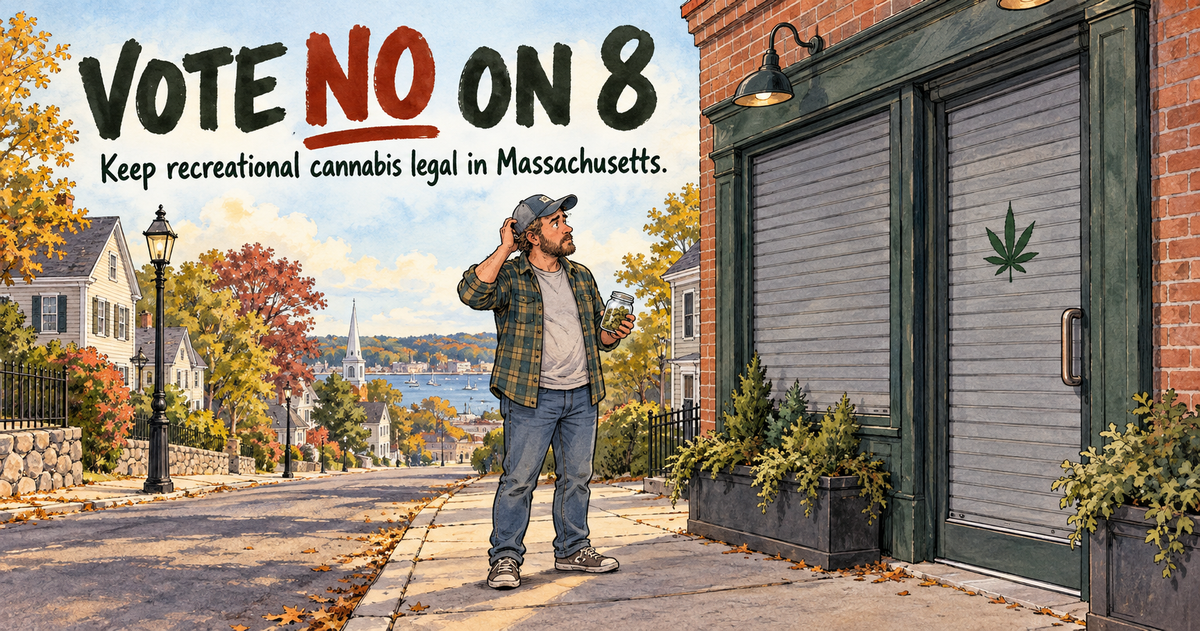
That is the contradiction at the center of Question 8, on the November 3 ballot. A yes vote would dismantle the state's regulated recreational market; a no vote would keep it. The proposal preserves medical marijuana and limited adult possession, but repeals the laws governing adult-use sales, cultivation and cannabis taxation. Its effective date is January 1, 2028—not the morning after Election Day.[1][2]
For recreational consumers, the practical question is obvious: where is that legal ounce supposed to come from? Unpaid, unadvertised gifts between adults would remain protected within the proposal's limits. A licensed Massachusetts recreational purchase would not. Neither would growing your own under the current adult-use rules.[2]
People do not necessarily stop wanting cannabis when a store closes. Removing regulated supply creates an opening for unlicensed sellers. It also gives police more cannabis conduct to enforce against, including home cultivation that the state currently permits. That is a poor trade if the aim is to keep officers available for violence, theft and dangerous driving.
Supporting legal recreational access does not require pretending cannabis is harmless or every operator deserves applause. It means asking whether removing the legal market would make the actual problems easier to solve.
Quick Hits
- Small possession would stay legal. For adults 21 and older, the proposal protects possession of up to one ounce, with no more than five grams in concentrate form. More than one ounce through two ounces would carry a $100 civil penalty and forfeiture, not a criminal conviction.[2]
- Home protections would shrink. Current law protects up to ten ounces at a primary residence, plus cannabis produced by lawful home cultivation, and permits up to six plants per adult with a twelve-plant household ceiling. Question 8 repeals the chapter containing those adult-use protections.[2][3]
- Medical access remains a separate route. The proposal continues the medical program and directs regulators to streamline existing operators' applications to join it. That is not a promise that every recreational shop—or every recreational customer's access—would survive unchanged.[2]
- The market just crossed $10 billion. The Cannabis Control Commission says cumulative adult-use gross sales passed that mark on September 5, counting from the first retail openings in November 2018. Sales are not tax receipts or profits.[4]
That's the news. The analysis is below — Science Desk, Market Watch, and a closing thought.
Science Desk
An Ohio study does not become Massachusetts data
In January, WAMC reported that a repeal-campaign spokesperson claimed drivers in fatal Massachusetts crashes tested positive for marijuana half the time. Asked for supporting evidence, the campaign supplied a fact sheet citing research from Ohio.[5]
The American College of Surgeons' account describes 246 deceased drivers tested for THC in Montgomery County, Ohio, from January 2019 through September 2024. Of those tested, 103—41.9 percent—were positive for active THC.[6]
That is a finding about tested deceased drivers in one county. It is not the percentage of Massachusetts fatal crashes involving cannabis. It is also not the percentage of crashes caused by cannabis.
The source matters, too. ACS identifies the work as a conference abstract selected by a program committee, not yet peer reviewed in that account. The release reports no statistically significant change in THC positivity before versus after Ohio legalization. That observation does not prove legalization has no effect on road safety; this limited study cannot settle that much larger question.[6]
There is no need to minimize impaired driving to correct the claim. NHTSA says cannabis can impair coordination, judgment and reaction time. It also cautions that a drug's presence in someone's system does not necessarily establish impairment. Driving after using an impairing substance is unsafe, and cannabis-impaired driving remains illegal.[7]
The useful policy questions concern preventing that harm: sober transport, clear warnings and enforcement focused on unsafe driving. A statistic from another state cannot establish that closing Massachusetts shops would reduce it.
What would police be asked to do again?
It would be inaccurate to describe Question 8 as bringing back arrests for every adult carrying a small amount. The text expressly protects possession within its one-ounce limit.[2]
But consider the person who lawfully keeps several ounces at home or grows a few plants. The current adult-use chapter protects that conduct within defined limits. Repeal removes those protections. Someone keeping more than one ounce through two ounces at home could face the proposal's civil fine and confiscation unless another lawful protection, such as medical authorization, applied. Larger amounts and cultivation lose the current adult-use shield.[2][3]
Investigating, confiscating, documenting and processing cannabis cases takes police time even when an offense is civil. How much extra work this proposal would create depends on enforcement decisions and consumer behavior; the petition supplies no estimate.
The priority question remains. Why expand enforcement against otherwise peaceful possession and home growing when those hours could go toward people facing serious harm? Police would still have a job addressing impaired driving, sales to children and other unlawful conduct under a regulated market. Keeping recreational access legal does not require abandoning those responsibilities.
Market Watch
Closing the shops does not erase the customers
The Commission's September 9 release reports approximately $336 million in cannabis sales, local and excise taxes for fiscal year 2026, citing the Department of Revenue. It separately reports almost $60 million in financial assistance through the Cannabis Social Equity Trust Fund since 2024.[4]
Those figures measure different things over different periods. They are not an estimate of repeal's future budget cost. They do show that the choice reaches beyond store owners: cities and towns, public programs and entrepreneurs from communities harmed by prohibition all have something at stake.
A large tax contribution does not excuse weak regulation. Nor does an equity license guarantee a well-run business. But dismantling legal adult-use commerce also removes the sales supporting that revenue, rather than fixing shortcomings in the system that collects it.
Some customers might stop using cannabis. Others might seek medical access, travel or buy from unlicensed sellers. We cannot responsibly assign percentages to those responses in advance. The concern is that repeal removes the regulated option without demonstrating that demand will disappear with it.
For consumers who move to unlicensed supply, Massachusetts cannot offer the same licensed chain of testing, labeling and accountability. Regulation needs scrutiny and improvement. Abandoning regulated recreational sales makes those safeguards unavailable through that channel.
The medical transition provision offers businesses a possible route forward, not a guarantee of replacement demand or a painless conversion. Keeping medical cannabis legal is important. It does not answer why an adult without medical authorization should lose the ability to buy recreational cannabis through a regulated Massachusetts seller.
The Last Word
Adults should be able to choose recreational cannabis within sensible rules. Children need protection. Roads need sober drivers. Consumers need reliable information and products that can be traced when something goes wrong. Those aims belong in the same policy.
Question 8 would preserve a narrow permission to possess cannabis while removing the ordinary legal ways recreational consumers obtain it. It would also put peaceful home growing and currently protected possession back into the enforcement picture.
Massachusetts should improve its regulated market, not send more of the problem back to police. Keep officers available for the crimes and emergencies people need them for. Keep a legal, accountable route for adults who choose to use cannabis.
— The Alkaloid
Sources
[1] Massachusetts Secretary of the Commonwealth: Ballot Question Numbers Assigned for November Ballot, July 21, 2026. Official confirmation of Question 8 and the November 3 election.
[2] Initiative petition 25-10, Version B: An Act to Restore a Sensible Marijuana Policy. Primary proposal, sections 1, 3–8 and 10; full eight-page text reviewed. Proposed law, not current law. Ballotpedia's ballot guide corroborates the yes/no mapping.
[3] Massachusetts General Laws, Chapter 94G, Section 7. Current statutory adult-use possession and home-cultivation protections; distinguishes home limits from other possession limits.
[4] Cannabis Control Commission: Massachusetts Marijuana Establishments Hit $10 Billion in Gross Sales, September 9, 2026. Agency administrative-data release; cumulative sales, FY2026 taxes and equity assistance have different reporting periods.
[5] WAMC: Group behind cannabis repeal effort in Massachusetts accused of using misleading tactics, January 21, 2026. Reported interview and documentation of the campaign's crash claim, not a crash dataset.
[6] American College of Surgeons: Over 40% of Deceased Drivers in Motor Vehicle Crashes Test Positive for THC, Study Shows, 2025. Institutional release about a conference abstract, not a peer-reviewed full paper in this source. Selected tested deceased drivers in one Ohio county; no Massachusetts estimate or causal attribution.
[7] NHTSA: Drug-Impaired Driving. Federal road-safety guidance on cannabis impairment and the limits of interpreting drug presence.
The Alkaloid publishes every Tuesday. Forward this to someone who needs the dose. Subscribe for full access: TheAlkaloid.com